

Yellow Jackets in Southern Maine:
Identification, Prevention, and Control
Yellowjackets are the stinging insect I get called about most often across Southern Maine, and for good reason. They build colonies that can reach several thousand workers by late summer, they nest in places people regularly disturb without realizing it, and they defend those nests aggressively with no warning. I handle yellowjacket calls regularly throughout Scarborough, Windham, Standish, and Hollis, where wooded edges, old stone walls, and older structures give them abundant nesting options right next to where people live and work. As an Associate Certified Entomologist (A.C.E.) with 16 years of experience in the region, accurate species identification is always my first step, because the treatment approach for a ground nest differs significantly from a wall void infestation. Browse the stinging insects pest library to compare species, or contact me if you need help with an active nest.
What Are Yellow Jackets?
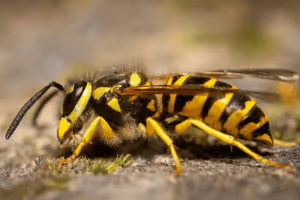
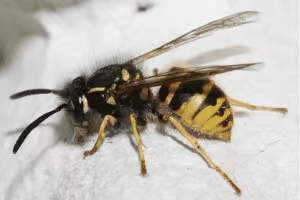
Yellowjackets are social wasps in the family Vespidae. Several species are found in Southern Maine, with the eastern yellowjacket (Vespula maculifrons) and the aerial yellowjacket (Dolichovespula arenaria) being the most commonly encountered. Adults measure about half an inch, with bold black and yellow banding, a distinctly narrow waist, and smoky wings that fold lengthwise along the body at rest. Their smooth, hairless bodies distinguish them from bees at a glance.
Colonies begin each spring when a single overwintered queen starts building a nest alone. Workers emerge and take over foraging and nest expansion as the colony grows, with populations reaching several hundred to several thousand workers by August and September. Nests are constructed from gray paper made of chewed wood fibers and are often completely hidden, inside ground burrows, wall voids, or beneath deck boards. The colony dies off with the first hard frost, but newly mated queens overwinter and the cycle restarts the following year. For detailed species identification and biology, the UMaine Extension guide on hornets, wasps, and yellowjackets is the most relevant local reference.
Signs of Yellowjacket Activity
Because yellowjacket nests are often hidden, the signs of activity are frequently the first indication a colony is present:
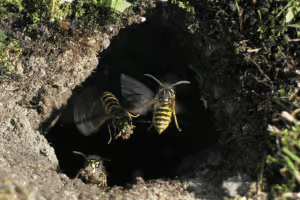
- A steady stream of wasps flying in and out of a small hole in the lawn, soil, or at the base of a wall
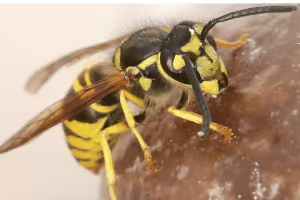
- Aggressive swarming behavior near garbage cans, outdoor dining areas, or sweet drinks
- Buzzing sounds from inside wall cavities, soffits, or attic voids
- Workers scraping wood from fences, siding, or deck boards to use as nest material
- Sudden increase in wasp numbers around foundation cracks or gaps in late summer
- Multiple simultaneous stings when walking near a ground nest that was not visible
In Scarborough and Windham properties, activity typically intensifies from July through October as colonies reach peak size and shift their foraging focus toward sugars and carbohydrates.
Risks in Southern Maine
Yellowjackets are the stinging insect most responsible for serious sting incidents in Southern Maine. Unlike honeybees, they can sting repeatedly without losing their stinger, and a disturbed colony will pursue and attack in numbers. For people with venom allergies, a single sting can trigger anaphylaxis requiring immediate medical attention. Even without a known allergy, a mass stinging event from a large colony carries genuine health risk. If you know or suspect you have a venom allergy, carry an epinephrine auto-injector and avoid any area with active yellowjacket activity.
Wall void nests are particularly hazardous because the colony can grow very large inside a structure before anyone realizes it’s there. Homeowners in Buxton and Limington with older homes regularly call me after discovering a wall void colony that has been active for most of the summer. Attempting to seal the entry point without treating the colony first almost always makes the situation worse, driving workers into the living space through gaps in the interior wall.
Yellowjacket ground nests are a particular hazard around lawn mowing, landscaping work, and children’s play areas. The vibration of a mower passing over a ground nest is one of the most common triggers for a mass sting incident.
Prevention Tips
Most yellowjacket problems can be reduced significantly with attention to the conditions that attract them and the gaps that allow them to establish nests inside structures:
- Keep all outdoor garbage and compost tightly sealed and clean bins regularly to eliminate the food sources that draw foraging workers
- Cover food and drinks at outdoor gatherings and never leave sweet beverages unattended, as yellowjackets will enter open cans and bottles
- Pick up fallen fruit, pet food, and spilled birdseed promptly
- Seal gaps around soffits, eaves, foundation vents, and exterior trim before spring to eliminate wall void nesting sites
- Mow lawns regularly through summer and watch for ground nest activity; early discovery in June or July means a much smaller colony to address
- Remove woodpiles, debris piles, and old rodent burrows near the foundation that provide ready ground nesting sites
- Inspect the exterior of structures each spring for early-stage nests while colonies are still small and manageable
- Consider a year-round protection plan that includes a spring inspection pass for early nest detection
Commonly Confused With
Yellowjackets are frequently confused with several other species:
Bald-faced hornets are closely related and similarly aggressive, but are larger, predominantly black with white markings, and build their nests in exposed aerial locations rather than enclosed spaces. If the nest is a large visible gray paper ball in a tree or on the side of a building, it’s a bald-faced hornet colony, not yellowjackets.
Paper wasps are slender with a more pronounced waist and build open-celled umbrella-shaped nests rather than enclosed paper envelopes. They are noticeably less aggressive than yellowjackets and tend to build in more visible, accessible locations like under eaves and in doorframes.
Honeybees are sometimes confused with yellowjackets by homeowners who see a swarm. Honeybees are golden-brown and fuzzy rather than smooth and bright yellow, fly with a distinct hovering pattern, and are generally docile. A honeybee swarm or established hive is typically handled by local beekeepers rather than pest control operators.
Professional Yellowjacket Control in Southern Maine
Yellowjacket treatment requires locating the nest accurately, timing the treatment correctly, and using the right products and protective equipment for the situation. Treating a wall void colony is a different job than treating a ground nest, and attempting either without professional preparation carries real risk. I start every job with a thorough inspection to locate the nest entrance, assess colony size and location, and determine the safest treatment approach. Ground nests and aerial nests are treated directly at the entrance in late evening when workers are inside and activity is lowest. Wall void colonies require careful product selection and application to reach the nest without driving workers into the living space. I’ve been handling yellowjacket calls across Cumberland and York Counties for 16 years, and my stinging insect control service covers residential and commercial properties throughout the region. Learn more about my background on the about page, or contact me to schedule a free consultation.
Frequently Asked Questions
Yes, particularly when a nest is disturbed. Yellowjackets sting repeatedly and a colony will pursue and attack in numbers. For people with venom allergies, a single sting can trigger anaphylaxis, which is a medical emergency. Even without a known allergy, a mass stinging event from a large colony is a serious health risk. Nests near high-traffic areas should be treated professionally rather than left alone or approached without preparation.
They seek sheltered, protected spaces for colony-building and follow food sources close to human activity. Ground burrows, wall voids, soffits, and spaces under decks are all commonly used nesting sites. Our humid wooded climate and abundance of older homes with gaps in the building envelope give yellowjackets reliable nesting options throughout the region. Late summer foraging for sugars brings them into close contact with outdoor food and drinks.
No. Disturbing an active yellowjacket colony without the right equipment, timing, and products is one of the most reliable ways to provoke a mass sting incident. This is especially true for wall void nests, where sealing the entry point without treating the colony first can drive thousands of workers into the living space. Professional treatment is faster, safer, and more effective.
Ready to Get Started?
If yellowjackets are nesting on your property or you’ve found a ground nest or wall void colony, reach out for a free consultation and I’ll assess the situation and treat it safely.