

Bald-faced Hornets in Southern Maine:
Identification, Prevention, and Control
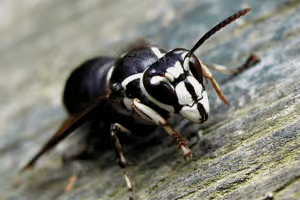
Bald-faced hornets are one of the most visually striking stinging insects in Southern Maine, and their nests are impossible to miss once a colony is established. I handle bald-faced hornet calls regularly across wooded communities like Hollis, Lyman, Limington, and Buxton, where mature trees and forest edges give colonies ideal aerial nesting sites close to homes and yards. What makes bald-faced hornets a genuine safety concern is not just their sting, which is painful and delivered repeatedly, but their defensive range. They will pursue and attack perceived threats well beyond the immediate nest area. As an Associate Certified Entomologist (A.C.E.) with 16 years of experience in the region, I treat every bald-faced hornet job with the respect the species deserves. Browse the stinging insects pest library to compare species, or contact me if you have an active nest that needs attention.
What Are Bald-faced Hornets?
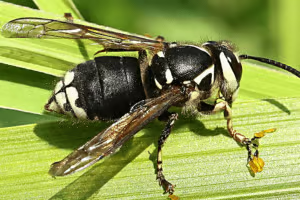
Bald-faced hornets (Dolichovespula maculata) are not true hornets but are closely related to yellowjackets, belonging to the same family Vespidae. Adults measure about three-quarters of an inch, with a stout black body and distinctive ivory-white markings on the face, thorax, and tip of the abdomen. The white facial markings are the clearest identifying feature and give the species its common name.
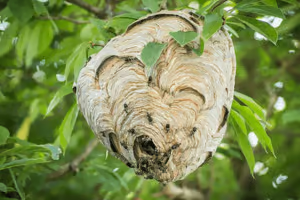
Colonies begin each spring when a single overwintered queen starts building a nest alone. Workers emerge and take over construction and foraging as the colony grows, with populations typically reaching 400 to 700 workers by late summer. The nest itself is one of the most recognizable structures in nature: a large, gray, football to basketball-shaped paper envelope constructed from chewed wood fibers mixed with saliva, with a single entrance hole at the bottom. Nests are built in a single season and are never reused, though new queens often select the same general area the following year. According to the UMaine Extension bald-faced hornet fact sheet, bald-faced hornets are among the most aggressive stinging insects encountered in Maine and their nests require professional handling.
Signs of Bald-Faced Hornet Activity
Bald-faced hornet activity is usually hard to miss once a colony is established, but early-season nests can be small enough to overlook:
- A large gray paper nest hanging from a tree branch, shrub, or under eaves, ranging from baseball-sized early in the season to football or basketball-sized by late summer
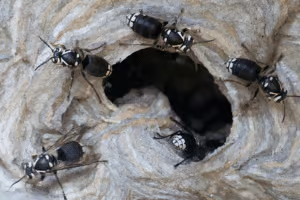
- A steady stream of black and white wasps flying in and out of the entrance hole at the bottom of the nest
- Workers scraping wood from fences, siding, or deck boards to gather material for nest construction
- Aggressive buzzing or diving behavior when anyone approaches within 10 to 15 feet of the nest
- Increased wasp activity near the nest during warm afternoons
- Empty gray paper nests remaining on branches through winter after the colony dies off in late fall
In Hollis and Lyman properties with mature tree canopies, nests are often well-established before they’re discovered, particularly when they’re positioned in dense foliage that conceals them until leaves begin to drop.
Risks in Southern Maine
Bald-faced hornets are among the most defensively aggressive stinging insects found in Maine. Unlike some wasp species that will tolerate moderate proximity to their nest, bald-faced hornets actively patrol a defensive perimeter and will pursue perceived threats a considerable distance from the nest. Stings are painful, delivered repeatedly, and can trigger severe allergic reactions in sensitized individuals. Anaphylaxis from stings is a medical emergency requiring immediate attention.
The combination of large colony size and aggressive defense makes bald-faced hornet nests near walkways, play areas, driveways, and patios a genuine safety hazard. Homeowners in Windham and Standish regularly call me after discovering nests that had been growing unnoticed in a tree near the yard all summer. By August, a nest that was the size of a baseball in June can house several hundred workers and represent a serious risk for anyone moving through the area. Attempting to remove an active bald-faced hornet nest without professional equipment is one of the more reliable ways to provoke a dangerous mass stinging incident.
Prevention Tips
Reducing bald-faced hornet nesting near structures is primarily a matter of eliminating the sheltered aerial sites they prefer and detecting early-season nests before they grow:
- Inspect trees, shrubs, and eaves weekly during June and July when nests are still small and far easier to address safely
- Trim tree branches and dense shrubs away from the house to reduce the sheltered canopy nesting sites bald-faced hornets prefer
- Seal gaps around soffits, fascia boards, and attic vents to eliminate any enclosed aerial nesting opportunities
- Remove old nests in late fall or winter after the colony has died; old nests occasionally attract new queens the following spring to the same general area
- Keep garbage tightly sealed and outdoor food covered, particularly from late July onward when foraging increases
- Consider a year-round protection plan that includes a spring inspection pass for early nest detection before colonies reach dangerous size
Commonly Confused With
Bald-faced hornets are most commonly confused with two other species:
Yellowjackets are closely related and similarly aggressive, but are smaller, with bright yellow and black banding rather than black and white markings. Yellowjackets build enclosed paper nests in ground burrows, wall voids, and enclosed aerial spaces rather than the large exposed aerial nests characteristic of bald-faced hornets. If the nest is visible and hanging in a tree or on the side of a structure, it’s almost certainly bald-faced hornets.
Paper wasps build open-celled umbrella-shaped nests without an outer paper envelope, most commonly under eaves, in doorframes, and on porch ceilings. They are slender with a pronounced narrow waist, reddish-brown to dark brown coloring with yellow markings, and are significantly less aggressive than bald-faced hornets. A small, open-celled nest without a paper covering is paper wasps, not hornets.
True hornets (Vespa species), specifically the European hornet, are occasionally encountered in Maine but are uncommon. European hornets are larger than bald-faced hornets, yellow and brown rather than black and white, and nest in hollow trees and wall voids rather than building aerial paper nests. Despite the common name, bald-faced hornets are not true hornets.
Professional Bald-Faced Hornet Control in Southern Maine
Bald-faced hornet treatment requires the right equipment, the right timing, and a clear plan before approaching the nest. I treat active nests at dusk or after dark when workers are inside and temperatures are lower, applying targeted products directly to the nest entrance to maximize contact with returning workers. Once the colony is eliminated I remove the nest material to prevent reoccupation. Every job is assessed individually: a nest in a high branch over a yard in Hollis requires different access and equipment than a nest under an eave in a commercial parking area in Saco. I’ve been handling bald-faced hornet calls across Cumberland and York Counties for 16 years, and my stinging insect control service covers residential and commercial properties throughout the region. Learn more about my background on the about page, or contact me to schedule a free consultation.
Frequently Asked Questions
Both species are highly defensive of their nests, but bald-faced hornets are generally considered more aggressive in terms of their defensive range. They actively patrol a perimeter around the nest and will pursue perceived threats further than most wasp species. A yellowjacket colony disturbed accidentally may sting the immediate area; a bald-faced hornet colony will pursue well beyond the nest. Any nest within 20 feet of a regularly used area warrants professional attention.
They select sheltered aerial sites with good structural support, abundant nearby insects for feeding larvae, and proximity to wood fiber for nest construction. Mature trees over yards, dense shrubs near foundations, and building overhangs with good canopy cover are all ideal. Southern Maine’s heavily wooded landscape and older residential properties provide exactly those conditions throughout Cumberland and York Counties.
Late evening or nighttime when most workers are inside the nest and temperatures have dropped. Cooler temperatures reduce activity and defensive behavior, and treating after dark means the majority of foraging workers are present in the nest rather than out in the field. Early season treatment in June or early July when the colony is still small is always preferable to waiting until August or September when populations are at their peak.
Ready to Get Started?
If there’s a bald-faced hornet nest on your property that’s creating a safety concern, reach out for a free consultation and I’ll assess the situation and treat it properly.