

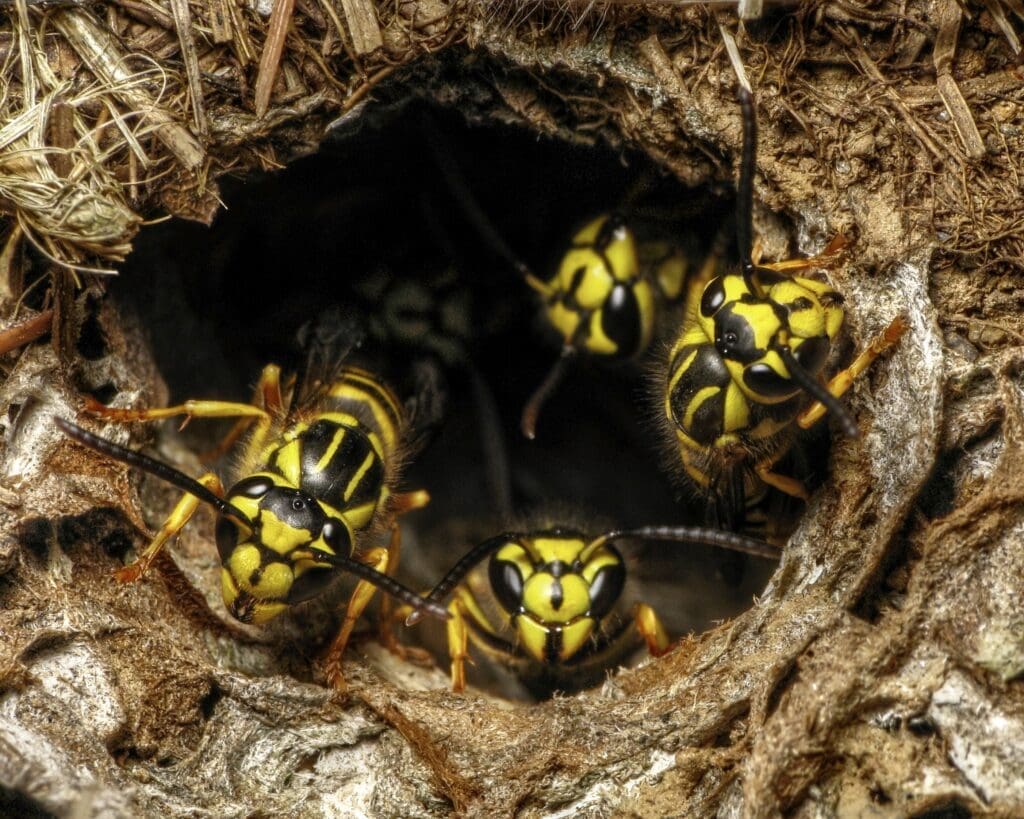
Yellow jackets are one of the most common calls I receive from late June through September in southern Maine. They are aggressive, they nest in locations that put people at risk, and they are frequently misidentified, which leads to the wrong response at the wrong time. As an Associate Certified Entomologist with more than 16 years of experience serving Cumberland and York Counties, here is what you actually need to know about stinging insects on your property this summer.
Not All Stinging Insects Are the Same
Before getting into yellow jackets specifically, it is worth knowing what you are dealing with. Several stinging insects are active in southern Maine through the summer and into fall, and they behave very differently from one another.
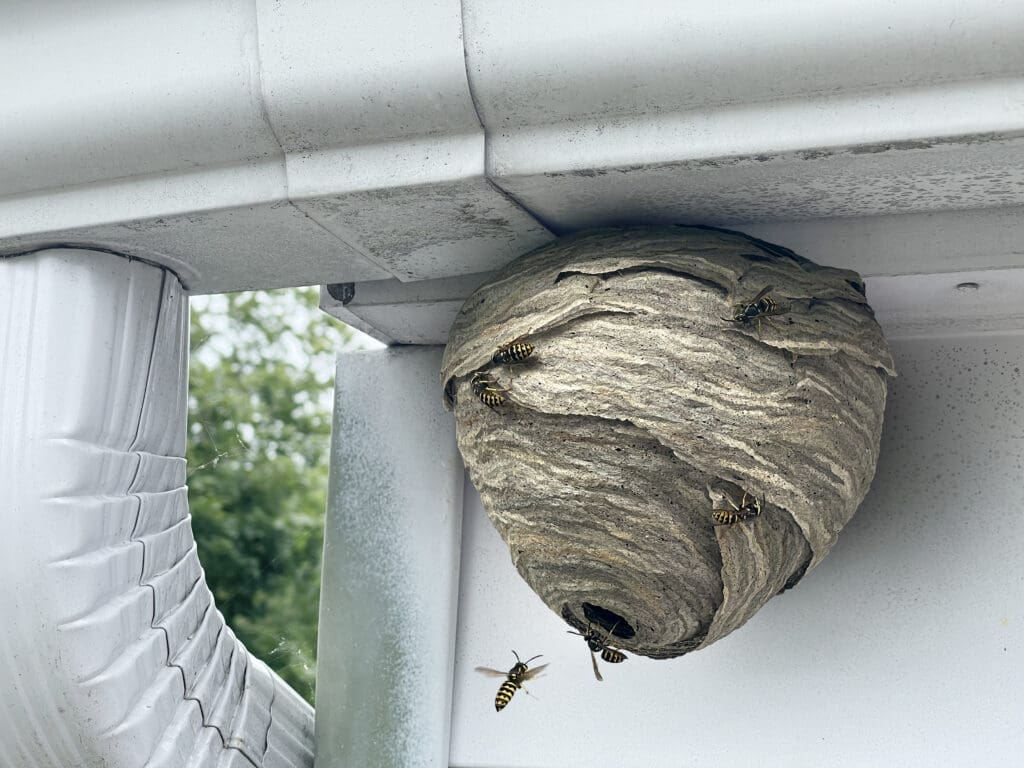
Yellow jackets are the most problematic species for most property owners. They are small, roughly half an inch long, with bold yellow and black banding. They build nests both in the ground and in aerial locations such as wall voids, eaves, attics, and shrubs. They are highly defensive of their nests and will sting repeatedly without provocation when they feel threatened. Late summer is when yellow jacket colonies are at their largest and their most aggressive.
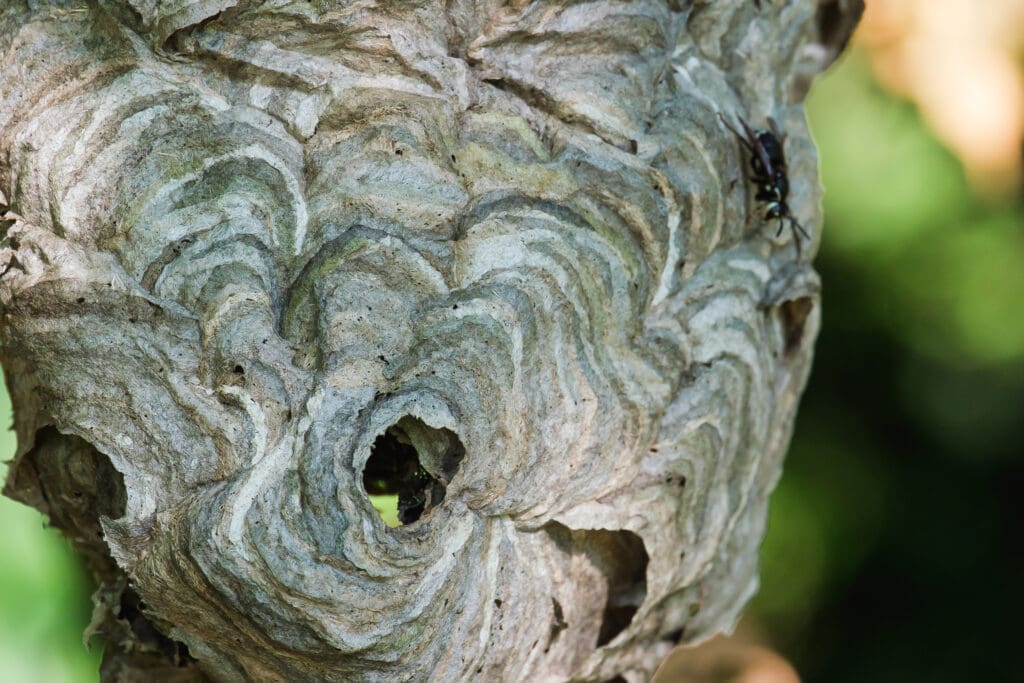
Bald-faced hornets are larger than yellow jackets, primarily black with white markings on the face and abdomen. They build the large, distinctive gray paper nests that look like a football and are often found hanging from tree branches, eaves, and utility structures. Bald-faced hornets are extremely aggressive defenders of their nest and will attack in force if the nest is disturbed. Their venom is also noted to cause more intense pain than a typical yellow jacket sting.
Paper wasps are slender, longer-bodied insects that build open-celled umbrella-shaped nests, often under eaves, deck railings, and window frames. They are considerably less aggressive than yellow jackets or bald-faced hornets and will generally only sting if the nest is directly disturbed or they are handled. While they should still be treated with respect, they present a lower risk in most situations.
Yellow Jacket Nests: Ground and Aerial
Yellow jackets in Maine nest in two primary locations and each presents its own challenges.
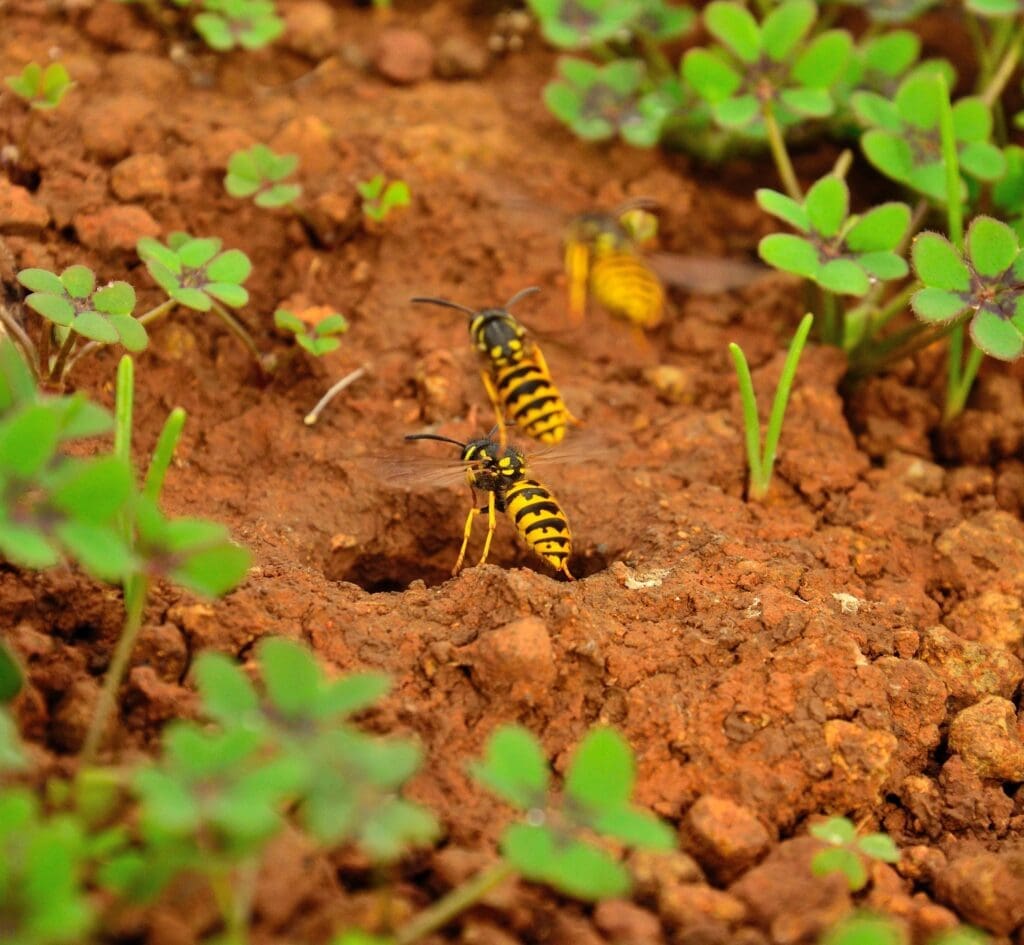
Ground nests are established in abandoned rodent burrows, root cavities, and voids in the soil. The entrance is typically a small hole in the ground, sometimes no bigger than a quarter, which makes them easy to miss until someone mows over one or steps near the entrance. Ground nests are particularly dangerous because the disturbance from a lawn mower, foot traffic, or even nearby vibration can trigger a rapid and aggressive defensive response. A mature ground nest by late summer can contain several thousand workers. Properties with active rodent pressure are more likely to develop ground nesting yellow jacket problems since abandoned burrows are a preferred nesting site.
Aerial nests are built in wall voids, behind siding, inside eaves, in attics, inside hollow trees, and occasionally inside structures like sheds and garages. A colony that gets inside a wall void can go undetected for weeks while the population grows. The first signs are often yellow jackets entering and exiting through a small gap in siding or trim, or worse, workers chewing through interior drywall as the nest expands.
Both nest types require different treatment approaches and neither is a good candidate for a do-it-yourself response once a colony is established.
Why Late Summer Is the Most Dangerous Time
Yellow jacket colonies start small in spring when a single overwintered queen begins building. By midsummer the population has grown significantly, and by August and September a mature colony can number in the thousands. This is also the time of year when natural food sources begin to decline, which drives yellow jackets to scavenge more aggressively around outdoor dining areas, garbage, and anything sweet or protein-based.
The combination of a large colony, a shrinking food supply, and shorter days makes late summer yellow jackets considerably more defensive and more likely to sting than earlier in the season. A nest that sat quietly in a wall void or under a deck through June and July can become a serious hazard by August.
This seasonal escalation is one of the reasons it pays to address a yellow jacket nest as soon as it is identified rather than waiting to see if it becomes a problem.
Why Over-the-Counter Products Are Risky
Store-bought wasp and hornet sprays can be effective on small, exposed paper wasp nests that are easy to access and treat completely. For yellow jacket ground nests and aerial nests inside wall voids or structural spaces, they are a different story.
Spraying the entrance of a ground nest with a consumer product without treating the interior of the nest typically does not eliminate the colony. It agitates it. Workers that survive the initial application pour out of the entrance in a defensive response and the person doing the treating is often in the middle of that response.
For nests inside wall voids, consumer sprays applied at the entry point can drive the colony deeper into the wall or cause workers to chew through into the interior of the living space looking for an exit. This is one of the more unpleasant outcomes of a mismanaged aerial nest treatment.
Bald-faced hornet nests should never be approached without proper protective equipment and a clear plan. The defensive response from a disturbed bald-faced hornet colony is immediate, coordinated, and can involve dozens of stings in seconds.
For Property Managers: Stinging Insects Are a Liability Issue
A yellow jacket ground nest along a walkway, near an entrance, or in a common area of a rental property is a liability exposure. Tenants, visitors, children, and anyone with an allergy to insect stings are at risk. Many people do not know they are allergic until their first serious reaction, which makes a nest in a common area a genuine hazard for any commercial property or rental in Cumberland or York County.
Responding promptly to tenant reports of stinging insect nests is not just good property management practice. It is the kind of documented, proactive response that matters if a sting incident ever results in a claim. Keep records of when the report came in, when treatment was completed, and by whom. Property managers in Portland, Standish, Naples, Limerick, and Cornish and the surrounding towns know that a fast, documented response is what separates a handled situation from a liability claim.
What to Do If You Find a Nest
- Do not approach the nest or attempt to block the entrance.
- Keep children and pets away from the area.
- Mark the location so others on the property are aware.
- Do not run a lawn mower or other power equipment near a ground nest entrance.
- Contact a licensed pest control professional for an inspection and treatment.
For ground nests, treatment is most effective in the early morning or evening when the majority of the colony is inside and activity at the entrance is minimal. For aerial nests in wall voids or structural spaces, a thorough inspection first is essential to understand the full extent of the nest before any treatment is applied.
Serving Southern Maine Homeowners and Property Managers
Precision Pest Control handles yellow jacket, bald-faced hornet, and paper wasp nest removal and treatment for homeowners and property managers throughout Portland, Scarborough, Biddeford, Saco, Standish, Limington, Naples, Cornish, and all of southern Maine. Every job is handled personally by an Associate Certified Entomologist with 16-plus years of experience.
If you have a stinging insect nest on your property that needs professional attention, visit the contact page to get in touch. The sooner a nest is addressed, the smaller and more manageable the colony will be. A year-round protection plan includes preventive treatment to help keep stinging insects from establishing on your property, with free service calls if an issue comes up between visits.