

House Flies in Southern Maine:
Identification, Prevention, and Control
House flies are the most common fly complaint I receive across Southern Maine, and they are also one of the more straightforward to resolve once the breeding source is identified and addressed. The challenge is that most homeowners focus on the flies they can see rather than the outdoor organic material sustaining continuous new generations. A single neglected garbage area, a compost pile too close to the house, or pet waste that accumulates in a backyard can keep a house fly problem going indefinitely regardless of how many flies are swatted indoors. I treat house fly problems regularly throughout Cumberland and York Counties, in both residential properties and the commercial food service and agricultural settings where they pose the most serious sanitation risk. As an Associate Certified Entomologist (A.C.E.) with 16 years of experience in the region, finding the source is always where I start. Browse the flies pest library to compare other species common in Maine, or contact me if house flies are not responding to basic sanitation steps.
What Are House Flies?
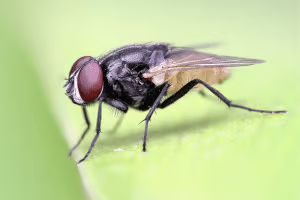
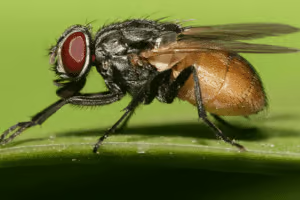
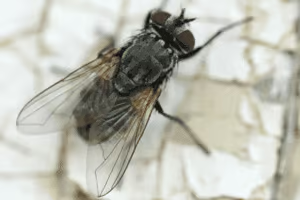
House flies (Musca domestica) are the most familiar domestic fly species in the world and the most commonly encountered fly indoors in Southern Maine. Adults are about one-quarter inch long, gray with four distinct dark stripes running lengthwise down the thorax, and large reddish compound eyes. They have sponging mouthparts rather than piercing mouthparts, meaning they do not bite but instead feed by regurgitating digestive fluids onto food surfaces and then absorbing the liquefied result.
Females lay batches of 75 to 150 eggs in moist decaying organic matter, and under the warm conditions of a Maine summer the full life cycle from egg to adult can complete in as little as seven to ten days. A single female can produce hundreds of offspring in her lifetime, which explains how a minor outdoor breeding source can translate into a significant indoor problem quickly. Browse the flies pest library to see other species found in the area.
According to the University of Maine Cooperative Extension, house flies are active throughout the warm season in Maine and are capable of traveling considerable distances from outdoor breeding sites to enter structures, making source control the foundation of any effective management approach.
Signs of House Fly Activity
House flies are not subtle. Signs of an active problem include:
- Flies landing repeatedly on countertops, food, tables, or windowsills during the day
- Persistent buzzing near garbage containers, pet food dishes, or outdoor organic waste
- Dark fecal and regurgitation spots on walls, ceilings, and light fixtures near resting areas
- Maggots or pupae visible in trash bins, compost, or moist organic debris near the foundation
- Large numbers of flies clustering on sunny interior walls in the morning before temperatures warm up
- Increased entry through doors during summer when outdoor populations are highest
In Southern Maine locations such as Saco and Scarborough these signs typically peak during the humid summer months from July through September when warm temperatures accelerate the breeding cycle and outdoor organic sources are at their most productive.
Risks in Southern Maine
House flies are a genuine public health concern in a way that many common pests are not. They do not bite, but they mechanically transmit over 65 documented pathogens by moving between filth sources and food preparation surfaces. Bacteria including Salmonella and E. coli are carried on their feet, bodies, and mouthparts and deposited wherever they land. Their feeding behavior, which involves regurgitating digestive fluids onto surfaces, creates direct contamination risk on any food or preparation surface they contact.
In commercial food service settings this makes house flies a serious sanitation and regulatory concern. My commercial pest control services address house fly management in restaurant kitchens, food processing facilities, agricultural operations, and other commercial environments where fly pressure intersects with health code compliance and food safety standards.
Prevention Tips
House fly prevention focuses on eliminating the outdoor organic breeding sources that sustain indoor populations:
- Keep all garbage in tightly sealed containers and empty them daily during summer, rinsing bins regularly with hot water
- Clean up pet waste daily and store pet food in sealed containers
- Keep compost bins sealed and positioned at least 50 feet from the house
- Rinse recyclable cans and bottles before placing them in bins
- Install or repair tight-fitting screens on all windows, doors, and vents
- Use door sweeps and weatherstripping to seal gaps around entries
- Reduce moisture around foundations and keep gutters clear
- Clean up spills, food scraps, and residue around outdoor cooking and dining areas promptly
For commercial properties where controlling fly pressure is an ongoing operational requirement, a structured year-round protection plan that includes regular monitoring and seasonal treatment is the most reliable approach.
Commonly Confused With
House flies are most commonly confused with cluster flies and blow flies. Cluster flies are larger, slower-moving, have golden hairs on the thorax, and appear in attics and upper rooms in fall and spring rather than being active year-round near food. Blow flies are similar in size but have a distinctive metallic blue, green, or bronze sheen and are strongly associated with decaying animal matter rather than general food waste. Little house flies are closely related but noticeably smaller and thinner, and are often seen flying in lazy circles in the center of rooms rather than landing on food surfaces. The four dark lengthwise stripes on the thorax and the red compound eyes are the most reliable identifiers for house flies.
Professional House Fly Control in Southern Maine
House fly treatment begins with locating and eliminating every outdoor breeding source contributing to the indoor problem. Killing adult flies without addressing the source produces only temporary relief since new adults emerge continuously from untreated breeding material. I inspect garbage areas, compost, pet waste zones, and the full perimeter of the structure to identify every contributing source before applying any treatment. Exterior bait stations, targeted residual applications to outdoor resting surfaces, and interior light traps and sticky traps address active adult populations while source elimination resolves the underlying problem. For commercial properties where house fly activity is a recurring operational and compliance concern, my commercial pest control services provide a structured integrated pest management program. You can learn more about my approach on the about page. My common pests control services cover house flies and the full range of fly species found in Cumberland and York Counties. Contact me to schedule a free consultation.
Frequently Asked Questions
House flies almost always breed outdoors in organic material near the structure rather than inside the kitchen itself. A sealed garbage can that was not rinsed, a compost pile within 50 feet of the house, accumulated pet waste in the yard, or a moist area near the foundation are the most common sources. Cleaning the kitchen eliminates a food attraction but not the breeding source, which is why the problem persists. Finding and addressing that outdoor source is the step that most DIY approaches skip.
Any consistent indoor presence of house flies during the warm season indicates an active outdoor breeding source within flying distance of the structure. A single fly wandering in through a door is normal. Multiple flies landing on food surfaces or gathering on windows daily is a sign of a breeding source that is close enough to produce consistent pressure and worth investigating.
Yes, though not through biting. House flies mechanically transfer pathogens from filth sources to food and preparation surfaces through their feet, bodies, and feeding behavior. They are documented carriers of Salmonella, E. coli, and numerous other pathogens. The risk is real and is why house fly control in commercial food service and agricultural settings is taken seriously from a regulatory standpoint.
Ready to Get Started?
If house flies are a recurring problem on your property, reach out for a free inspection and I will identify the source.