

Fleas and Ticks in Southern Maine:
Identification & Prevention
Fleas and ticks are ectoparasites that feed on the blood of mammals and birds and rely on hosts for survival and reproduction. In Southern Maine they represent the most health-significant pest category on this site, with deer ticks being the primary vector for Lyme disease, anaplasmosis, and babesiosis in the region, and fleas being the leading cause of indoor infestations on pets and one of the harder pest problems to fully eliminate without a systematic approach. Maine consistently reports among the highest Lyme disease rates in the country, and tick populations have expanded their range and remained active later into fall as winters have become less severe. As an Associate Certified Entomologist (A.C.E.) with 16 years of experience in the region, I handle flea and tick situations with the same attention to identification and life cycle that determines whether a treatment works or falls short. Browse the species covered below, or contact me for help. Dedicated mosquito and tick control services are available for properties throughout Southern Maine.
Quick Fact: In Southern Maine, deer tick nymphs, roughly the size of a poppy seed, are responsible for the majority of Lyme disease transmission to people, precisely because they are small enough to go unnoticed during the window when prompt removal would prevent infection.
Common Fleas & Ticks in Southern Maine
Why Fleas and Ticks Are a Concern in Southern Maine
Southern Maine’s wooded landscape, abundant deer population, and warm-season humidity create ideal conditions for both fleas and ticks. The region consistently ranks among the highest in the country for Lyme disease incidence, and tick populations have expanded and remained active later into fall in recent years as winters have become less severe.
Fleas are introduced almost exclusively through animal hosts, primarily pets that spend time outdoors, but also wildlife like raccoons, opossums, and deer mice that pass through or den near a structure. Once fleas are brought inside on a host, they rapidly establish an environmental infestation in carpeting, upholstery, and pet bedding that cannot be resolved by treating the animal alone.
Ticks are encountered primarily outdoors in wooded areas, along forest edges, in tall grass, and in areas with heavy leaf litter, exactly the kind of habitat that defines much of Southern Maine’s residential landscape. Ticks do not jump or fly. They quest by climbing vegetation and waiting to attach to a passing host, and people and pets pick them up by brushing through infested vegetation.
Identification Tips for Fleas and Ticks in Southern Maine
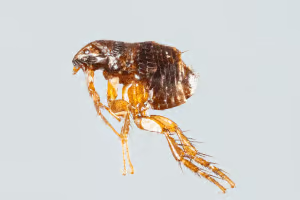
Cat fleas (Ctenocephalides felis) are responsible for the vast majority of flea infestations on both cats and dogs in Southern Maine. Adults are approximately one sixteenth of an inch long, reddish-brown, wingless, and laterally flattened, which allows rapid movement through fur. Flea dirt (fecal matter) is a reliable indicator of active infestation: small dark specks on pet bedding or fur that turn reddish-brown when moistened on a white tissue. Flea larvae are small, white, and worm-like, living off-host in carpeting, floor cracks, and pet resting areas.
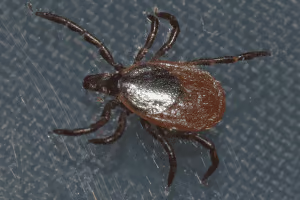
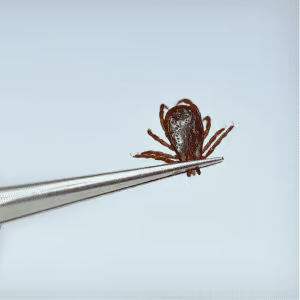
Deer ticks (Ixodes scapularis, also called blacklegged ticks) are the most medically significant tick in Southern Maine. Adults are approximately one eighth of an inch, dark reddish-brown with a solid black scutum and no patterning. Nymphs are roughly the size of a poppy seed and responsible for the majority of Lyme disease transmission because their small size allows them to feed undetected through the critical window. Deer ticks are active spring through fall and on mild winter days above freezing.
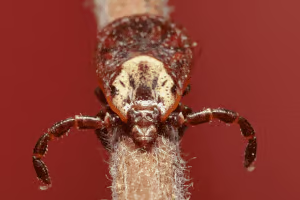
American dog ticks (Dermacentor variabilis) are larger than deer ticks at approximately three sixteenths of an inch unfed, brown with distinctive white or silver-gray mottling on the scutum. Most active in spring and early summer, they are the primary vector for Rocky Mountain spotted fever and tularemia in the region.
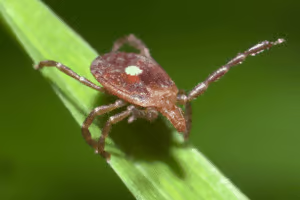
Lone star ticks (Amblyomma americanum) are medium-sized and reddish-brown, with females easily identified by a single white spot at the center of the scutum. An expanding species now documented in York and Cumberland counties, they are associated with ehrlichiosis, tularemia, and alpha-gal syndrome, and quest actively rather than waiting passively on vegetation.
Behavior & Habits of Fleas and Ticks in Southern Maine
The cat flea life cycle has four stages: egg, larva, pupa, and adult. Adult fleas on a pet represent only a fraction of the total infestation. Eggs fall off the host into the environment almost immediately after being laid, and larvae develop in carpeting, floor cracks, and bedding. Pupae are encased in sticky cocoons that adhere to carpet fibers and are highly resistant to insecticides, remaining viable for months and emerging when vibration or heat signals a host is nearby. This is why vacating a home for several weeks and returning to find immediate flea activity is a common experience. Effective flea treatment must address the environment, including carpets, furniture, and pet bedding, as thoroughly as it addresses the animal host.
Ticks are slow-moving and entirely dependent on finding a host. Deer ticks use a three-host life cycle, taking a blood meal at each of three life stages from different hosts. Deer mice are the primary reservoir for the Lyme disease bacterium (Borrelia burgdorferi) and are the host on which larval deer ticks most commonly acquire infection. Nymphs then transmit it to people and pets. Once attached, a tick must typically feed for 36 to 48 hours before Lyme disease transmission occurs, which is why prompt daily tick checks and careful removal matter.
Risks & Threats from Fleas and Ticks in Southern Maine
Fleas and ticks carry some of the most significant pest-related health risks in Maine. The Maine CDC ticks page and the UMaine Extension Tick Lab are the authoritative Maine-specific resources for disease risk, tick identification, and current surveillance data.
Lyme disease, transmitted by deer ticks, is the most commonly reported tickborne illness in Maine, with early symptoms including a characteristic expanding rash, fever, and fatigue, and untreated infection capable of causing joint, neurological, and cardiac complications. Anaplasmosis and babesiosis are also transmitted by deer ticks and are increasing in incidence statewide, with babesiosis particularly severe in immunocompromised individuals and the elderly. Rocky Mountain spotted fever is transmitted by American dog ticks and requires prompt treatment. Alpha-gal syndrome is associated with lone star tick bites and causes an acquired allergy to red meat and mammal-derived products, a recently recognized and increasing concern as lone star tick range expands northward.
Flea allergy dermatitis is the most common skin condition in cats and dogs and can be triggered by a single bite in sensitized animals. Fleas also serve as an intermediate host for the dog tapeworm (Dipylidium caninum), and severe infestations can cause significant blood loss in small pets, kittens, and puppies.
Prevention Tips for Fleas and Ticks in Southern Maine
- Apply veterinarian-recommended flea and tick preventives to all pets year-round; seasonal application is insufficient since deer ticks are active on mild days throughout winter
- Perform daily tick checks on people and pets after any outdoor activity in wooded or grassy areas, paying particular attention to the scalp, behind ears, underarms, groin, and behind the knees
- Remove attached ticks promptly using fine-tipped tweezers, grasping as close to the skin surface as possible and pulling upward with steady pressure without twisting, squeezing, or using heat or petroleum jelly
- Keep lawns mowed short, clear leaf litter from yard edges, and create a wood chip or gravel buffer between lawn and wooded areas to reduce tick habitat close to the structure
- Vacuum carpets, upholstered furniture, and pet resting areas thoroughly and frequently during any active flea situation and dispose of vacuum bags immediately outside
- Wash pet bedding in hot water weekly during and after any flea infestation
- Address wildlife activity near the structure, as deer mice, raccoons, and other wildlife introduce both fleas and ticks; rodent control and nuisance wildlife control reduce the reservoir population on the property
Frequently Asked Questions
Size and markings are the most reliable distinguishing features. Deer ticks are smaller, roughly one eighth of an inch unfed as adults, with a dark reddish-brown body and a solid black scutum with no patterning. American dog ticks are noticeably larger, brown with distinctive white or silver-gray mottled markings on the scutum. Deer ticks transmit Lyme disease and are active year-round on mild days. Dog ticks are most active in spring and early summer and do not transmit Lyme disease.
Because only a small fraction of a flea infestation lives on the pet. The majority of the population, eggs, larvae, and pupae, lives in the environment in carpeting, floor cracks, and upholstered furniture. Flea pupae are encased in sticky cocoons that are nearly impervious to insecticides and can remain viable for months, emerging in response to vibration and warmth. Effective resolution requires simultaneous treatment of the pet and comprehensive treatment of the indoor environment, repeated at intervals that account for the development time of eggs and larvae already present when treatment begins.
Lyme disease transmission typically requires the tick to be attached and feeding for 36 to 48 hours or more. Prompt removal substantially reduces transmission risk. The characteristic expanding rash can appear anywhere from three to thirty days after a bite and does not always have the bullseye pattern. Any expanding rash following a tick bite, or flu-like symptoms including fever, fatigue, and joint pain during tick season, warrants prompt evaluation by a healthcare provider. Ticks can be submitted to the UMaine Extension Tick Lab for identification and testing at no charge for Maine residents.
Yes, though they are less established than deer ticks and dog ticks. They have been expanding northward for years and are now documented in York and Cumberland counties. They are more aggressive host-seekers than deer ticks, actively questing rather than waiting on vegetation, and are associated with ehrlichiosis, tularemia, and alpha-gal syndrome. Any tick with a single white spot on the back of the female should be identified and noted.
No. Lyme disease is transmitted exclusively by deer ticks (Ixodes scapularis). Fleas are not vectors for Lyme disease. Fleas can transmit other pathogens including murine typhus and serve as intermediate hosts for tapeworms, but Lyme disease is not among them.
The primary advantage is a properly timed treatment schedule, appropriate product selection for the life stages present, and comprehensive coverage of all harborage areas including furniture, carpeting, and cracks where larvae and pupae develop. Over-the-counter products are often applied once and only to accessible surfaces, while pupal populations survive and emerge in waves over subsequent weeks. A professional treatment accounts for flea life cycle timing and includes follow-up to address organisms that were in protected stages when the initial treatment was applied.
Professional Flea and Tick Control in Southern Maine
Fleas and ticks are the two pest categories where the health consequences of inadequate management are most direct. A flea infestation that is partially treated and recurs puts pets and people through repeated exposure and expense. A tick population in an active yard creates ongoing disease exposure risk through an entire season. Both respond well to professional treatment when the approach accounts for the full biology of the pest rather than just the visible adults. Learn more about my background and credentials on the about page, or visit the mosquito and tick control service page for detail on what yard tick programs cover. Contact me to schedule a free inspection.