

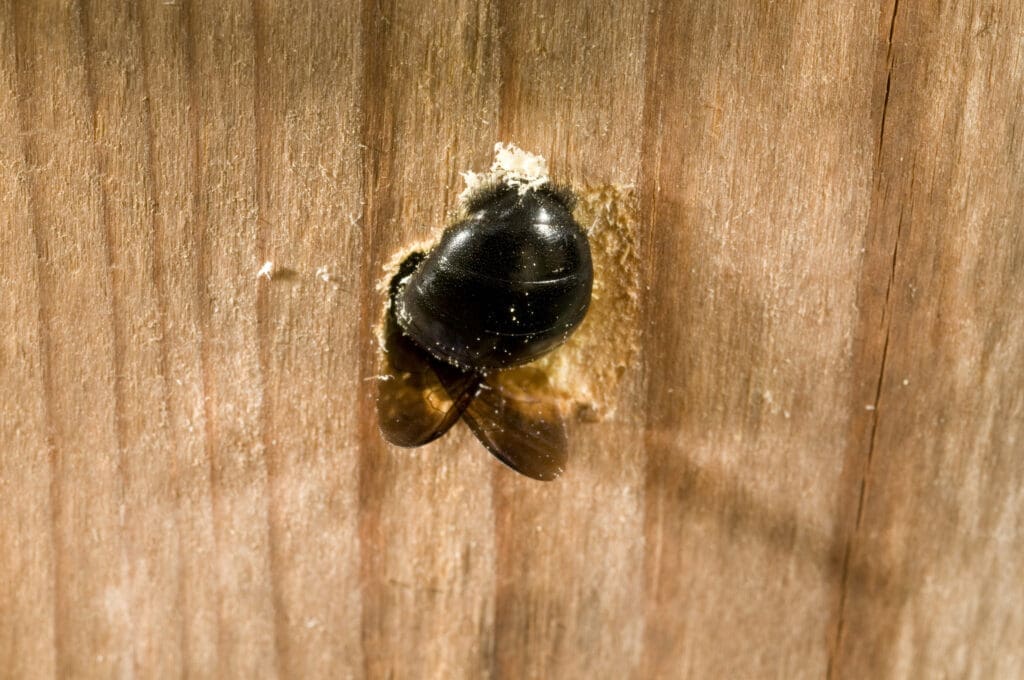
If you have noticed large, shiny black bees hovering aggressively around your eaves, deck, or fence this spring, those are almost certainly carpenter bees, and the hovering male is the least of your problems. The female drilling into your wood is the one that matters.
Carpenter bees are active across southern Maine right now, and spring is the window when the most damage gets done. Here is what you need to know.
What You Are Dealing With
The Eastern carpenter bee (Xylocopa virginica) is the species found in New England. At a glance it resembles a bumblebee, but there is a straightforward way to tell them apart: a carpenter bee has a shiny, hairless black abdomen. A bumblebee is fuzzy all over.
The bee you see hovering and dive-bombing near the nest site is the male. He is territorial, he is loud, and he has no stinger. He is entirely harmless. The female, on the other hand, is the one boring a perfectly round half-inch hole into your wood. She can sting but almost never does unless handled directly.
Where They Target
Carpenter bees prefer bare, unpainted, or weathered softwood. In southern Maine the most common targets are:
- Fascia boards and rake boards
- Deck railings and decking boards
- Wood siding, especially cedar
- Porch overhangs and eaves
- Wooden fences and gates
- Outdoor furniture and swing sets
- Wooden sills and trim around garage doors
Painted or stained wood is significantly less attractive to them. Bare pressure-treated wood is not immune. Any exposed wood surface is a potential target if conditions are right.
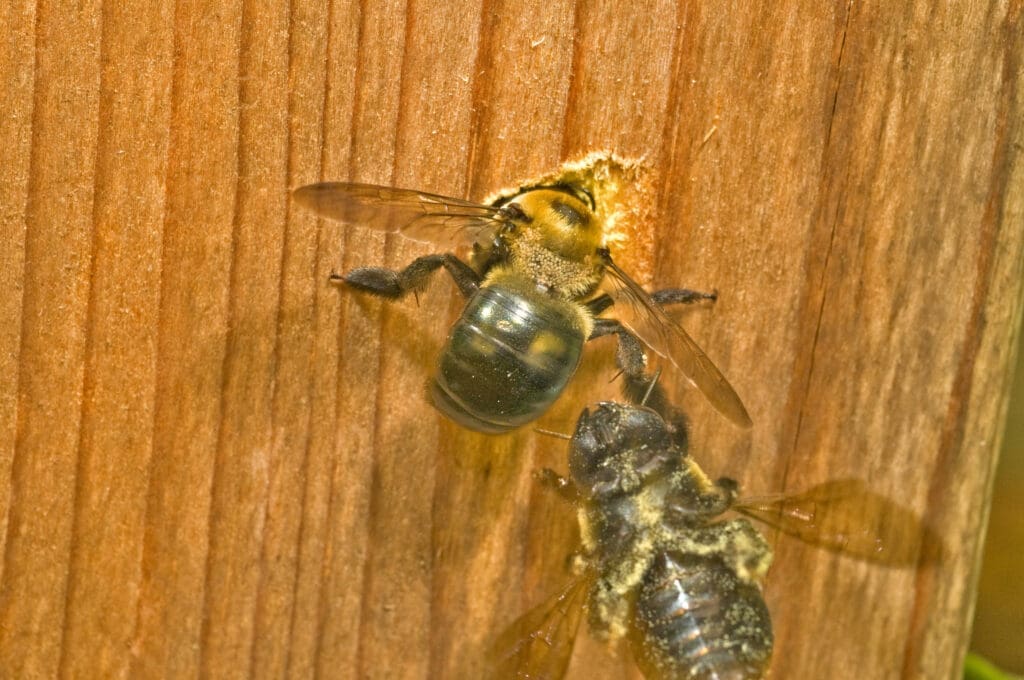
The Life Cycle and Why Timing Matters
Adult carpenter bees spend the winter inside the tunnels they or their parents excavated the previous season. In Maine they typically emerge in April or May as temperatures climb, mate within a few weeks, and the female gets to work boring new tunnels or expanding old ones.
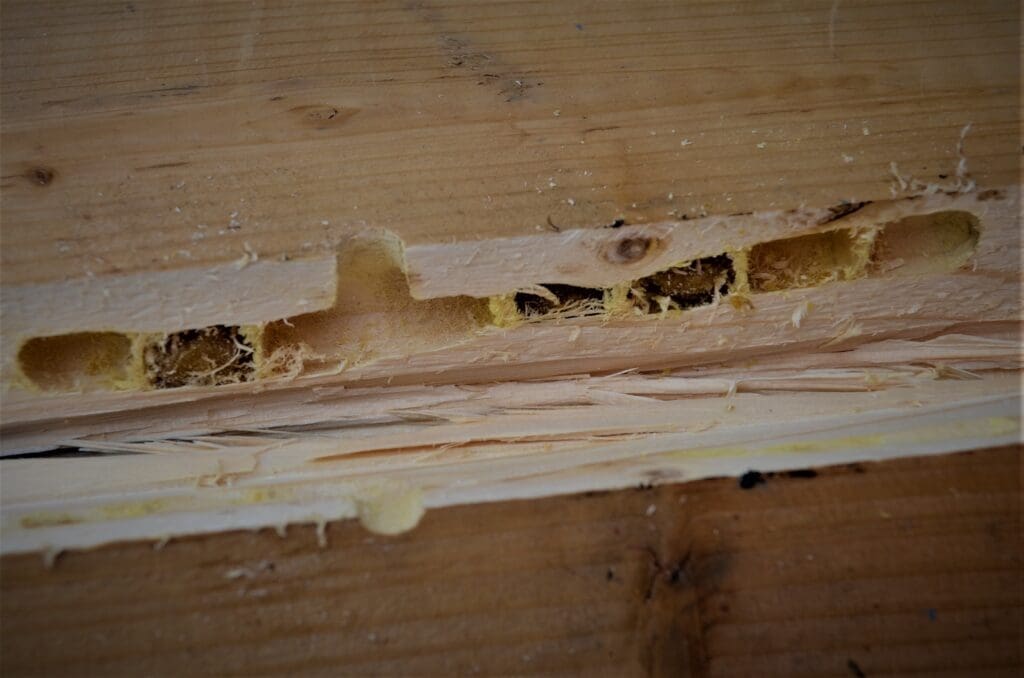
She bores straight in about an inch, then makes a sharp right-angle turn and continues parallel to the wood grain. Inside this gallery she creates individual cells separated by chewed wood pulp partitions. Each cell gets a ball of pollen and nectar, an egg laid on top, and then gets sealed off. A single gallery can hold six to eight cells.
The eggs hatch and the larvae develop through summer. New adults emerge in late summer, typically August and September, and spend several weeks foraging on pollen before returning to existing tunnels to overwinter. Then the cycle repeats the following spring.
The cumulative damage problem is what catches homeowners off guard. A single carpenter bee boring a single tunnel in year one seems minor. But those new adults return to the same structure the following spring, and they expand existing tunnels while boring new ones nearby. Galleries as long as ten feet have been documented in heavily infested structures. What started as a few small holes in a fascia board can become an extensively tunneled member after several seasons of unchecked activity, and the woodpeckers that follow to extract the larvae often cause more visible damage than the bees themselves.
The Paint Additive Question
Some homeowners ask about paint additives that repel carpenter bees. These products do exist. The most commonly referenced is NBS 30, a plant oil-based additive mixed into exterior paint or stain at roughly three ounces per gallon. It deters bees from boring into treated surfaces and is non-toxic to people and pets.
The practical limitation is longevity. Most of these products last one to two years in the paint before the active ingredient breaks down, meaning you are effectively repainting every year or two to maintain protection. For most homeowners that is not a realistic maintenance schedule, and a targeted residual treatment applied by a professional to the active areas will accomplish more at lower cost than repainting an entire structure annually. The additive makes sense if you are already planning to paint anyway, but it is not a standalone solution.
What Actually Works
The most effective approach for an active carpenter bee problem combines treatment of existing tunnels with a residual application to the surrounding wood. Insecticidal dust applied into active tunnels and left open long enough for bees to contact it and carry it deeper into the gallery is the standard method. Sealing the holes before treatment or before the new generation has fully emerged traps larvae inside and prevents the dust from doing its job.
Timing matters here too. A treatment during active boring season eliminates the females currently doing damage, and a follow-up visit the following early spring before new adults emerge and begin mating breaks the cycle before the next generation can expand the gallery and compound the damage.
Prevention Going Forward
The most reliable long-term prevention is paint or stain on all exposed wood surfaces. Bare wood is an invitation. Keeping all exterior wood on the house coated, especially trim, fascia, and any decorative elements, removes the primary attractant. Replacing any severely damaged wood before repainting gives the treatment a clean surface to protect.
If you are seeing active boring activity on your property this spring, contact me for a free assessment. I will take a look at what is happening and give you an honest recommendation for the most practical approach given your specific situation.