

Red Flour Beetles in Southern Maine:
Identification, Prevention, and Control
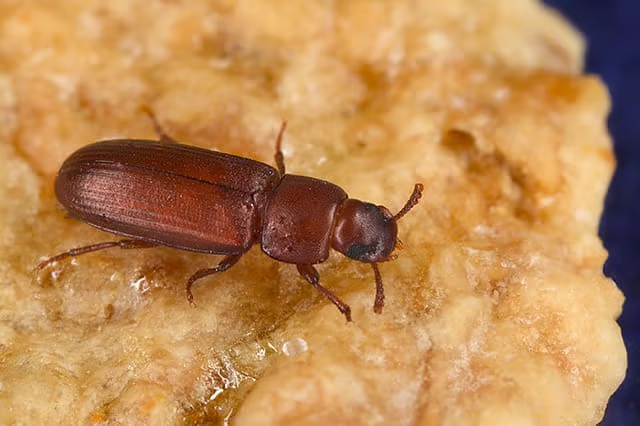
Red flour beetles are among the most common pantry beetles in Southern Maine, and they share the distinction of being the species most frequently confused with their close relative the confused flour beetle. Both infest the same products, produce similar damage, and look nearly identical at a glance. The red flour beetle does have a few meaningful differences: it can fly, which allows it to spread more readily between food sources, and it produces a more noticeable quinone secretion that gives heavily infested flour a stronger off odor and more pronounced discoloration than confused flour beetle infestations. I find red flour beetles regularly in homes throughout Portland and Saco as well as in Scarborough and Biddeford, typically introduced through infested purchased grain products. As an Associate Certified Entomologist (A.C.E.) with 16 years of experience in the region, getting the species identification right shapes both the treatment approach and what other areas of a home or business need to be inspected. Browse the stored product pests library to compare species, or contact me for identification and treatment help.
What Are Red Flour Beetles?
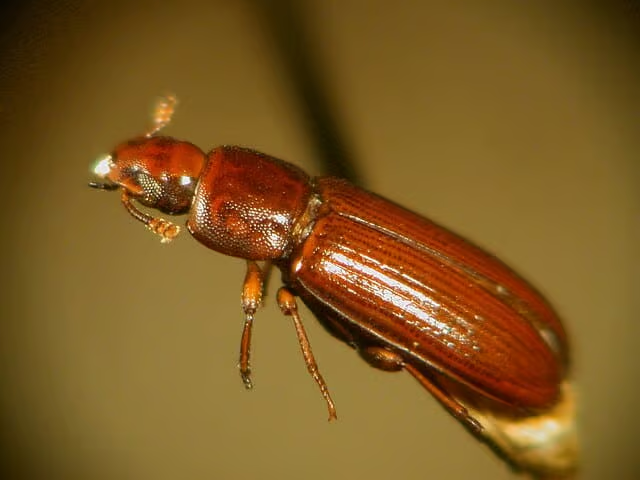
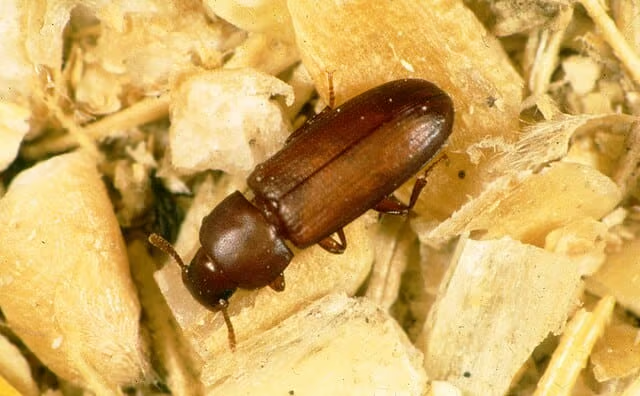
The red flour beetle (Tribolium castaneum) belongs to the family Tenebrionidae, the darkling beetles. Adults are 3 to 4 millimeters long, reddish-brown, flattened, and oval, with antennae that end abruptly in a distinct three-segmented club. This abrupt club is the key feature distinguishing them from confused flour beetles, whose antennae gradually enlarge over four segments without a pronounced club. Red flour beetles have functional wings and fly readily when disturbed, which is a practical behavioral difference from the non-flying confused flour beetle.
The larvae are the feeding stage: small, worm-like, yellowish-white grubs with brown heads and two small dark spines at the rear end, developing inside finely milled food products and contaminating everything they contact with frass, cast skins, and quinone secretions. The quinone secretion is more potent in red flour beetles than in confused flour beetles, which is why heavily infested flour sometimes has a noticeably stronger musty or chemical off odor. Red flour beetles are primarily associated with finely milled products including flour, cornmeal, cereal, cake mix, and similar items. They do not develop inside whole intact kernels. For detailed identification and comparison with the confused flour beetle, Penn State Extension’s pantry pests guide covers both species in detail.
Signs of a Red Flour Beetle Infestation
Red flour beetle signs are nearly identical to those of the confused flour beetle, with one practical difference: because adults fly, they may be found in areas removed from the obvious food source more frequently:
- Small reddish-brown adult beetles crawling on pantry shelves, inside packages, flying near lights, or found on windowsills away from the kitchen
- Fine dusty frass mixed into flour, cornmeal, cereal, or spices
- A pronounced musty or acrid odor in heavily infested products, more noticeable than with confused flour beetles due to stronger quinone secretions
- A grayish or pinkish tint to heavily infested flour from beetle secretions
- Tiny yellowish-white larvae or grubs inside infested products
- Clumped or caked flour and grain from larval tunneling and moisture accumulation
- Empty pupal cases or shed larval skins in pantry cracks, corners, and shelf edges
In Portland and Saco homes, activity increases during warmer months when temperatures favor rapid larval development and after introducing infested purchased products. The ability of adults to fly means they can sometimes be found in rooms adjacent to the pantry.
Risks in Southern Maine
Red flour beetles pose no health risk to people or pets. They do not bite, sting, or spread disease. The quinone secretions that give infested flour its off odor and discoloration are unpleasant but not a significant health concern for most people. The stronger secretion of the red flour beetle compared to the confused flour beetle means that infestations are sometimes noticed by smell before visual signs appear.
The primary concern is food contamination and loss. Red flour beetles are particularly significant in commercial food service settings such as bakeries and restaurants because their ability to fly allows them to spread from an infested storage area to food preparation surfaces more readily than non-flying species. In commercial kitchens, a red flour beetle infestation represents an immediate food safety and regulatory concern.
Prevention Tips
Red flour beetle prevention follows the same principles as confused flour beetle prevention, with one additional consideration given their ability to fly:
- Transfer all flour, cornmeal, cereals, spices, and other finely milled products into airtight glass or hard-sided plastic containers as the single most effective preventive step
- Inspect new grocery items for beetles or dust before storing them
- Rotate stock consistently, using older products before newer ones
- Clean pantry shelves, corners, and cracks regularly including under appliances
- Discard any infested items in sealed bags in outdoor trash immediately
- Keep indoor humidity below 50 percent, as warm humid conditions accelerate larval development
- Place pheromone monitoring traps designed for flour beetles in pantry areas for early detection
- Because adults fly, check adjacent storage areas and rooms if adults are found away from the obvious food source
- Consider a year-round protection plan for properties with persistent pantry pest activity or significant bulk grain storage
Commonly Confused With
Red flour beetles are most commonly confused with two other stored product beetles:
Confused flour beetles (Tribolium confusum) are the most important comparison. The two species are nearly identical in size, color, and habitat. The key distinction is the antennae: red flour beetle antennae end abruptly in a distinct three-segmented club, while confused flour beetle antennae gradually enlarge over four segments without a pronounced club. Red flour beetles can also fly, while confused flour beetles cannot. Both species infest the same finely milled products and are treated identically, but the flying ability of red flour beetles means they may spread more widely through a home or commercial kitchen.
Sawtoothed grain beetles and merchant grain beetles are similarly small and reddish-brown but have the distinctive row of six saw-tooth projections along each side of the thorax that flour beetles lack entirely. Grain beetles also infest a broader range of packaged products rather than primarily finely milled flour and meal.
Professional Red Flour Beetle Control in Southern Maine
Effective red flour beetle treatment starts with locating and removing all infested source materials, because treating pantry surfaces without eliminating the breeding sources produces only temporary results. Because adults can fly, the inspection needs to cover not just the food storage areas but any adjacent spaces where beetles may have spread. I start every job with a thorough inspection of all food storage areas and adjacent spaces to identify every active breeding site. All confirmed infested products are identified for disposal. Targeted residual treatments and insect growth regulators are applied only to cracks, crevices, and confirmed activity areas with no broad spraying near food surfaces. Storage recommendations are part of every job because reinfestation from newly purchased infested products is the most common reason a resolved problem returns. I’ve been handling pantry pest calls across Cumberland and York Counties for 16 years, and my common pests control service covers red flour beetles alongside the full range of stored product pests. Learn more about my background on the about page, or contact me to schedule a free inspection.
Frequently Asked Questions
No. Red flour beetles do not bite, sting, or spread disease. Their impact is entirely on stored food products. The quinone secretions they produce can give heavily infested flour a stronger off odor and discoloration than confused flour beetle infestations, but this is a quality and contamination concern rather than a health risk.
The most reliable distinguishing feature is the antennae: red flour beetle antennae end abruptly in a distinct three-segmented club, while confused flour beetle antennae gradually enlarge over four segments. Red flour beetles can also fly, while confused flour beetles cannot. Red flour beetles also produce a stronger quinone secretion that gives infested flour a more pronounced off odor. Both species infest the same finely milled products and are treated the same way.
With thorough removal of all infested source materials, targeted professional treatment, and proper food storage, most active infestations resolve within four to eight weeks. Because adults can fly, monitoring adjacent areas for beetles in the weeks following initial treatment is advisable to confirm the population has been fully eliminated. Reinfestation from newly purchased infested products is the most common reason a resolved problem returns.
Ready to Get Started?
If you’re finding small reddish-brown beetles in your flour, cereals, or pantry shelves, reach out for a free inspection and I’ll locate all active breeding sites and put together a plan to resolve it.