

Wolf Spiders in Southern Maine:
Identification, Prevention, and Control
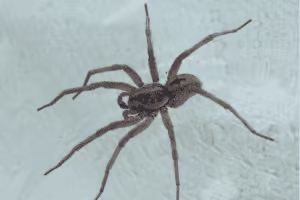
Wolf spiders are the largest free-roaming spider most Southern Maine homeowners will ever find inside their home, and the size and speed of a wolf spider crossing a basement floor at night tends to get people’s attention. I encounter them regularly on properties throughout Biddeford, Saco, Hollis, and Buxton, particularly on wooded lots and properties near fields and wetlands where wolf spiders are most abundant outdoors. They’re active hunters, not web-builders, and the ones found indoors are almost always accidental wanderers that came in through a gap at ground level rather than established indoor residents. As an Associate Certified Entomologist (A.C.E.) with 16 years of experience in the region, I can tell you that wolf spiders are among the most beneficial spiders in Maine outdoors, and indoors they’re more startling than they are a problem. Browse the spiders pest library to compare other species found in Southern Maine, or contact me if you’d like a professional assessment.
What Are Wolf Spiders?
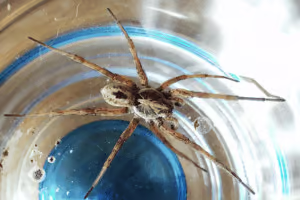
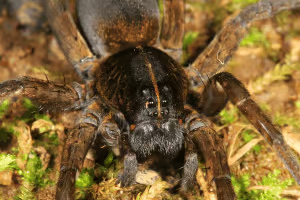
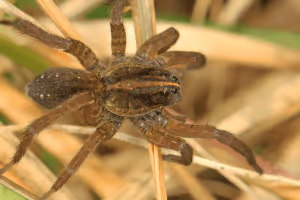
Wolf spiders belong to the family Lycosidae, a large and diverse family with dozens of species present in Maine. Adults range from about a quarter inch to over an inch in body length depending on species, with leg spans reaching three to four inches in the larger species. They have robust, slightly hairy bodies in brown, gray, or tan with darker stripes or mottled markings, and eight eyes arranged in three rows, with two large forward-facing eyes in the middle row that reflect light distinctly at night.
Unlike house spiders and cellar spiders, wolf spiders build no webs. They hunt actively on the ground, chasing or ambushing prey using speed and excellent vision. Females carry a round white egg sac attached beneath the abdomen until eggs hatch, then carry spiderlings on their back for a period before they disperse. They feed on beetles, ants, flies, crickets, and other ground-level insects, making them genuinely valuable in gardens and yards. According to the UMaine Extension spiders fact sheet, wolf spiders are among the most commonly encountered larger spiders in Maine and play an important role in controlling insect populations outdoors.
Signs of Wolf Spider Activity
Because wolf spiders are active hunters rather than web-builders, the signs are different from what you’d look for with other spider species:
- Large, fast-moving spiders on floors, patios, or basement slabs, particularly at night
- Bright eye shine when a flashlight beam hits them in a dark area outdoors or in a basement
- Females carrying a round white egg sac attached beneath the abdomen in late summer
- Spiderlings clustered on the mother’s back in late summer and early fall
- Small silk-lined burrows or retreats in mulch, soil, or under rocks near the foundation
- Sudden increase in indoor sightings near garage doors, basement entries, and thresholds in late summer and fall, when males are wandering in search of mates
Risks in Southern Maine
Wolf spiders are not dangerous. Bites occur only when a spider is directly handled or compressed against skin, and the effects are mild, comparable to a minor bee sting with brief localized redness or swelling. They carry no disease, show no aggression toward people, and cause no structural damage whatsoever.
The main concern is simply the startling nature of encountering a large, fast-moving spider indoors. On rural and wooded properties in towns like Hollis, Limington, and Waterboro, where wolf spider habitat is abundant right up to the foundation, repeated indoor sightings in fall are common. The more productive question in those situations is not how to eliminate wolf spiders but how to seal the ground-level entry points they’re using, because the same gaps letting in wolf spiders are also letting in ants, rodents, and other pests.
Prevention Tips
Wolf spiders found indoors are almost always accidental wanderers that entered through a gap at ground level. Exclusion is the most effective approach:
- Seal gaps around door frames, window frames, foundation cracks, and utility penetrations at or near ground level with caulk, weatherstripping, or steel wool
- Install tight-fitting door sweeps on all exterior doors, particularly garage doors and basement entries
- Clear leaf litter, woodpiles, rock piles, and dense low vegetation away from the foundation, as these are the primary outdoor harborage areas wolf spiders use
- Keep grass trimmed short and cut back shrubs along the foundation perimeter
- Reduce outdoor lighting near entry points or switch to yellow bulbs, as lights attract the insects that in turn attract wolf spiders to the perimeter
- Address any known rodent or insect activity around the foundation, since the prey populations that support wolf spiders outdoors are also drawing them toward the structure
- Consider a year-round protection plan for ongoing monitoring if wolf spider entry is a recurring seasonal problem
Commonly Confused With
Wolf spiders are most commonly confused with two other species:
Brown recluses are a frequent point of concern for homeowners who find a large brown spider indoors. Brown recluses are not established in Maine, and the large brown spiders found on basement floors in Southern Maine are almost certainly wolf spiders. The key distinction: brown recluses are smaller, have a violin-shaped marking on the cephalothorax, and have six eyes arranged in pairs rather than wolf spiders’ distinctive three-row arrangement of eight eyes.
Fishing spiders (Dolomedes species) are large, similarly patterned spiders found in Maine that are occasionally confused with wolf spiders. Fishing spiders are typically found near water, are somewhat larger, and have a pale stripe running along each side of the body. They’re more commonly spotted near ponds, streams, and wetland edges. Fishing spiders are also harmless.
House spiders are occasionally called wolf spiders by homeowners when found on floors, but house spiders are much smaller, paler, and associated with webs in corners rather than active ground-level movement.
Professional Wolf Spider Control in Southern Maine
For most homeowners, consistent exclusion work at the foundation level is enough to keep wolf spiders from becoming a recurring indoor problem. When they’re appearing in significant numbers or entering through gaps that are difficult to locate and seal, I start with a thorough inspection of the foundation perimeter, ground-level entry points, and the outdoor habitat conditions adjacent to the structure. From there I seal entry points, address the insect prey activity drawing them close, and apply targeted perimeter treatment only where evidence indicates it’s warranted. No broad spraying and no unnecessary chemicals. Learn more about my background and credentials on the about page, or visit my common pests control service page for a full overview of how I handle spiders and related pest activity. Contact me to schedule a free consultation.
Frequently Asked Questions
No. Wolf spiders are not dangerous. Bites are rare, occur only when the spider is handled or compressed, and produce mild effects comparable to a minor bee sting. They carry no disease and show no aggression toward people or pets. Their size and speed are startling but not a health risk.
Wolf spiders found indoors are almost always accidental wanderers that entered through a gap at ground level, typically males searching for mates or spiders following prey in late summer and fall. They are not establishing themselves indoors the way house spiders or cellar spiders do. Sealing ground-level entry points is the most effective way to prevent them from entering.
Brown recluses are not established in Maine, so the large brown spider you’re finding indoors is almost certainly a wolf spider. Wolf spiders are larger and more robust, have eight eyes arranged in three distinct rows with two prominent forward-facing eyes in the middle, and lack the violin-shaped marking on the back that identifies a brown recluse. If you’re uncertain about an identification, a professional assessment will give you a definitive answer.
Ready to Get Started?
If wolf spiders are making their way into your home each fall, reach out for a free consultation and I’ll identify where they’re entering and what it will take to keep them out.