

Asian Lady Beetles in Southern Maine:
Identification, Prevention, and Control
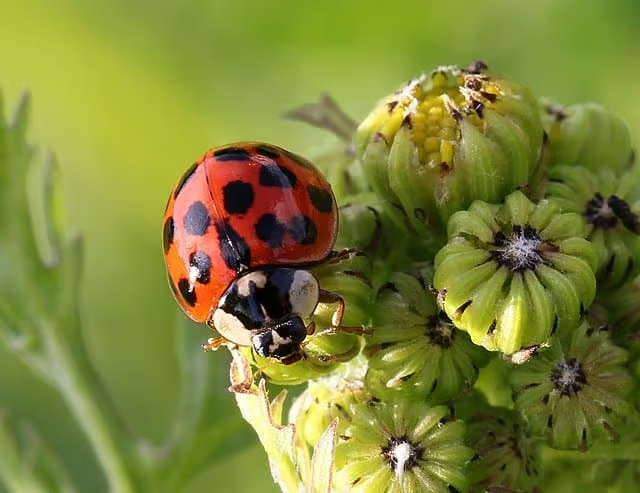
Multicolored Asian lady beetles are one of the most consistent fall nuisance pests in Southern Maine, and one of the more frustrating to deal with because of the volume of individuals that can enter a structure in a short window of time. Unlike western conifer seed bugs, which enter as solitary individuals, Asian lady beetles aggregate in large groups and can put hundreds or thousands of beetles into wall voids and attics over the course of a few warm October days. They are harmless to the structure itself, but the defensive fluid they release when disturbed stains surfaces, and some people have genuine allergic reactions to prolonged exposure. Properties with light-colored south-facing walls and significant aphid-host tree cover nearby see the heaviest activity, particularly across Windham, Scarborough, Hollis, and Lyman. As an Associate Certified Entomologist (A.C.E.) with 16 years of experience in the region, accurate identification is always my starting point. Browse the occasional invaders pest library to see other species found in the area, or contact me for identification and treatment help.
What Are Asian Lady Beetles?
The multicolored Asian lady beetle (Harmonia axyridis) is an introduced species originally from eastern Asia that was deliberately released in the United States beginning in the early twentieth century as a biological control agent for aphids and other soft-bodied plant pests. It is now well-established across North America and is one of the most abundant lady beetle species in Maine.
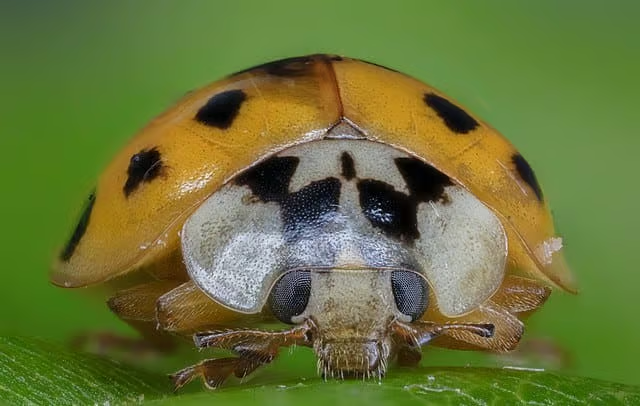
Adults are approximately one quarter of an inch long and strongly oval in shape, similar in form to native ladybugs but slightly larger and more domed. The most reliable single identification feature is the large black M-shaped or W-shaped marking on the white pronotum (the plate just behind the head), which is consistent across all color forms of the species. Color and spot count vary enormously: individuals range from pale yellow-orange with no spots to deep red-orange with up to 22 black spots, and some individuals are almost entirely black with a few red spots. This color variability is the source of most identification confusion with native ladybug species.
When disturbed or handled, Asian lady beetles practice reflex bleeding, releasing a small amount of yellowish defensive fluid called hemolymph from their leg joints. This fluid has a strong, unpleasant odor and is what causes the characteristic staining on walls, curtains, and fabrics. It is the same mechanism used by native ladybugs but more pronounced in this species due to the larger population densities it reaches indoors. According to the UMaine Extension multicolored Asian lady beetle page, this species is widely distributed throughout Maine and is a common presence in homes from October through early spring.
Signs of Asian Lady Beetle Activity
Asian lady beetle activity follows a predictable seasonal pattern that makes identification of the problem straightforward once you know what to look for.
Look for:
- Large aggregations of small orange to red spotted beetles on south and west-facing exterior walls, window frames, and roof edges on warm fall days, typically from late September through November
- Beetles found on interior walls, ceilings, window sills, and light fixtures from October through early spring, with the highest indoor activity on warm sunny days when wall voids heat up enough to trigger movement
- Yellowish staining on window sills, curtains, walls, and light-colored surfaces where beetles have released defensive fluid
- A persistent unpleasant odor in rooms or areas where beetles have been aggregating or where they have been crushed
- Beetles emerging in apparent confusion toward light sources on warm late-winter days as they respond to temperature cues from inside the heated structure
- Clusters of beetles found in attic insulation, behind wall plates and outlets, and in the space behind siding during winter inspections
Asian lady beetle pressure tends to peak on the first warm days following the first hard frosts in fall, as the temperature drop triggers the overwintering migration toward structures. Properties in Casco and Raymond with light-colored south-facing siding and established hardwood trees tend to see particularly heavy aggregation during this period.
Risks in Southern Maine
Asian lady beetles do not damage structures, do not feed on household materials, and do not reproduce indoors. The practical risks fall into two categories: staining and allergic reactions.
The staining from reflex bleeding fluid is real and difficult to remove from fabric, curtains, wallpaper, and light-colored painted surfaces. It is the primary reason vacuuming is strongly preferable to swatting or crushing when dealing with indoor beetles. The odor associated with the fluid can also become pronounced in enclosed spaces where large numbers of beetles have been disturbed or have died.
The allergic reaction risk is more significant than is commonly acknowledged. A portion of the population develops genuine allergic responses to exposure to Asian lady beetles, including rhinitis (hay fever-like symptoms), conjunctivitis, asthma-like respiratory symptoms, and contact dermatitis from skin contact with the defensive fluid. These reactions are distinct from simple annoyance and can be significant for sensitive individuals who spend extended time in spaces where beetle populations are large. The Maine DACF Got Pests lady beetles page notes this species as a common household nuisance in Maine with particular concern for individuals with insect-related sensitivities.
Prevention Tips
Prevention for Asian lady beetles is almost identical to the approach for boxelder bugs since both are mass-aggregating overwintering species that enter through the same types of gaps:
- Seal all gaps around window frames, door frames, utility penetrations, and siding with quality silicone or silicone-latex caulk before late September, when fall aggregation typically begins
- Pay particular attention to gaps where siding meets trim boards and at the roofline, as these are the most common mass entry points
- Install and maintain tight-fitting door sweeps on all exterior doors
- Screen attic louvers, ridge vents, and soffit vents with fine-mesh hardware cloth
- Repair or replace damaged window and door screens before fall
- Reduce exterior lighting near entry points on fall evenings, as lights attract aggregating beetles
- Vacuum aggregations from exterior walls using a shop vac rather than disturbing them by other means, and dispose of the bag away from the structure
- Indoors, vacuum beetles rather than crushing them to avoid staining and odor, and dispose of the bag promptly
Commonly Confused With
Asian lady beetles are most commonly confused with native ladybug species, and the distinction matters because native ladybugs are beneficial insects that should be left alone rather than treated.
Native ladybugs, including the seven-spotted lady beetle (Coccinella septempunctata) and the two-spotted lady beetle (Adalia bipunctata), are generally smaller than Asian lady beetles, have a more consistent spot pattern, and lack the white pronotum with the M or W marking that is the most reliable single identification feature for the Asian species. Native ladybugs also do not aggregate in large numbers on building exteriors in fall the way Asian lady beetles do. A few individuals of a native species is typical; hundreds of beetles on a south-facing wall in October almost certainly indicates Asian lady beetles.
Boxelder bugs aggregate on building exteriors at the same time of year and can be found on the same walls, but are immediately distinguishable by their black and red-orange coloring and elongated true bug body shape rather than the round dome of a beetle.
Brown marmorated stink bugs are another fall overwintering species found on the same exterior walls, but are shield-shaped, mottled brown, and significantly larger than Asian lady beetles.
Professional Asian Lady Beetle Control in Southern Maine
For most Asian lady beetle situations, thorough exterior sealing before fall and vacuuming of any beetles that make it indoors is the appropriate response. When populations are very large, entry points are difficult to locate and seal on an older structure, or repeated heavy indoor invasions are causing significant staining or allergy symptoms for household members, a perimeter treatment applied before the fall aggregation period can provide meaningful reduction alongside exclusion work.
As an A.C.E.-credentialed pest professional I can confirm identification, distinguish Asian lady beetles from native species that should not be treated, identify the primary entry points driving the indoor occurrence, and recommend the most targeted and cost-effective response for your specific situation. Learn more about my background and credentials on the about page, or visit the common pests service page for more detail. Contact me to schedule a free inspection.
Frequently Asked Questions
The most reliable single feature is the pronotum, the plate just behind the head. In Asian lady beetles it is white with a large black M or W marking. Native ladybugs have a darker pronotum without this distinctive marking. Color and spot count alone are not reliable for identification since Asian lady beetles are extremely variable, but the M or W marking is consistent across all color forms of the species. If you are seeing large aggregations on exterior walls in fall, they are almost certainly Asian lady beetles regardless of exact color, as native ladybugs do not aggregate in this way.
Yes. A meaningful portion of the population develops documented allergic responses to Asian lady beetles with repeated or heavy exposure, including hay fever-like nasal symptoms, eye irritation, and in some cases respiratory symptoms similar to mild asthma. Contact with the defensive fluid can also cause skin irritation in sensitive individuals. These are immunological responses rather than psychological ones, and people in households with persistent heavy indoor populations during winter sometimes report significant symptom improvement after the beetles are sealed out.
Treating inside wall voids after beetles are already overwintering there is generally not recommended. The beetles are not actively feeding or reproducing and will exit on their own in spring. Insecticide applied inside a void kills beetles in place, and large numbers of dead insects inside walls can attract secondary pests like carpet beetles and larder beetles that feed on the carcasses. The productive approach is sealing the entry points so the problem does not repeat the following fall.
Ready to Get Started?
If Asian lady beetles are getting into your home in large numbers, causing staining, or triggering allergy symptoms in household members, reach out for a free inspection and I will identify the entry points and recommend the most practical approach for your situation.