

No See Ums in Southern Maine:
Identification, Prevention, and Control
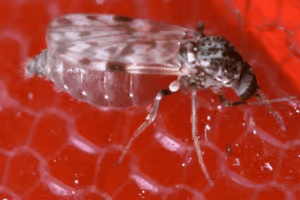
No-see-ums are one of the most frustrating biting insects in Southern Maine precisely because you cannot see them. The bite appears, the itch sets in, and there is nothing visible to swat or avoid. They are especially prevalent along the coast and near the salt marshes, tidal wetlands, and low-lying damp areas that are characteristic of much of Cumberland and York Counties, and they are most active at exactly the times of day when people most want to be outdoors in summer. Like black flies, deer flies, and horse flies, no-see-ums are not a pest I treat. Their breeding habitat spans large natural wetland areas well beyond the scope of property-level pest control. What I can offer is accurate identification and practical guidance for reducing exposure in our specific coastal environment. Browse the flies pest library to compare other species common in Maine, or contact me if you are unsure what is biting you.
What Are No See Ums?
No-see-ums, also called biting midges or punkies, belong to the family Ceratopogonidae. They are among the smallest biting insects you will encounter in Southern Maine, measuring only about one-sixteenth to one-eighth of an inch in length. Their tiny size is what makes them so difficult to detect and so frustrating to deal with. They can pass through standard window screens, making typical exclusion measures less effective than they are for larger insects.
Females require a blood meal to develop eggs and bite aggressively during their peak activity periods. Males feed only on nectar. In Southern Maine they breed in salt marshes, muddy wetland margins, and moist organic soil along coastal and low-lying areas. The full life cycle can complete in two to six weeks under warm humid conditions. Browse the flies pest library to see other species found in the area.
According to Purdue University Extension, biting midges are found worldwide wherever suitable moist breeding habitat exists, and coastal areas with abundant salt marsh and tidal wetland are among the most productive environments for their development.

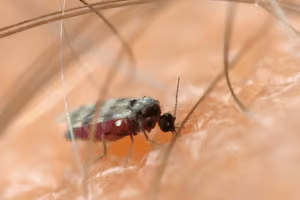
Signs of No-See-Um Activity
The defining characteristic of no-see-um activity is bites without a visible insect. Look for:
- Sudden sharp pinprick bites on exposed skin with no visible insect present
- Intensely itchy red welts appearing on ankles, wrists, neck, and any exposed skin, often in clusters
- Activity concentrated at dawn and dusk or on overcast calm humid days
- Swarms that appear as barely visible clouds hovering near the ground or around people outdoors
- Bites occurring even through thin clothing
- Welts that persist and itch for days, longer than typical mosquito bites
In Southern Maine locations such as Biddeford and Scarborough where coastal salt marshes, tidal areas, and low-lying wetlands are abundant, no-see-um pressure is typically highest from June through September, with the worst activity during calm humid evenings near the coast.
Risks in Southern Maine
No-see-ums in Maine do not transmit diseases to humans. Their impact is the immediate sharp pain of the bite, which is disproportionately intense for such a small insect, followed by itchy welts that commonly persist for several days and can last considerably longer in people with sensitivities. Allergic reactions with more significant swelling are not uncommon, and heavily bitten areas that are scratched can develop secondary skin infections.
For people who live near or regularly visit the coastal areas, salt marshes, and tidal wetlands of Cumberland and York Counties, no-see-ums can make dawn and dusk outdoors genuinely uncomfortable through much of the summer season.
Prevention Tips
Since professional treatment is not practical for no-see-ums, personal protection is the most effective tool available:
- Apply EPA-approved repellents containing DEET, picaridin, or oil of lemon eucalyptus to all exposed skin and clothing. The University of Maine Cooperative Extension guide on insect repellents provides detailed guidance on repellent selection and application for Maine conditions
- Wear long sleeves, long pants, and light-colored clothing during peak activity at dawn and dusk
- Install fine-mesh screens of 20 by 20 mesh or smaller on windows, doors, and porch enclosures since standard screens are too coarse to exclude no-see-ums
- Run fans on outdoor seating areas since no-see-ums are extremely weak fliers and even moderate air movement prevents them from landing
- Avoid outdoor activity at dawn and dusk during calm, humid weather near coastal or wetland areas when activity is most intense
- Choose outdoor activities during the middle of the day when no-see-ums are less active
Commonly Confused With
No-see-ums are most commonly confused with black flies and mosquitoes. Black flies are larger and visible, bite during daylight hours near fast-moving streams in spring, and produce a different type of wound than the pinprick bite of a no-see-um. Mosquitoes are significantly larger with long legs and a proboscis, make an audible whine in flight, and are most active at dusk rather than both dawn and dusk. The key identifier for no-see-ums is the combination of an intensely itchy bite with no visible insect, particularly near coastal or wetland areas at dawn or dusk. If you are being bitten but cannot see what is doing it, no-see-ums are almost certainly the answer in a coastal Southern Maine setting.
About No-See-Um Control in Southern Maine
No-see-ums breed in salt marshes, tidal wetlands, and coastal low areas throughout the region, well beyond the reach of any property-level treatment. Because their breeding habitat spans the broader landscape, targeted pest control is not an effective solution for this species. Personal protection, fine-mesh screens, and fans are the most practical tools available during peak season. If you are being bitten and are not certain whether no-see-ums are responsible or whether a different treatable species is involved, I am happy to help with identification. My common pests control services cover a wide range of fly and biting insect species that do respond to professional treatment. Contact me any time.
Frequently Asked Questions
Salt marshes, tidal flats, and coastal wetlands are ideal breeding habitat for biting midges. The moist organic soil and decaying vegetation at the margins of these habitats provide exactly the conditions their larvae need to develop. Southern Maine’s coastline through Cumberland and York Counties, including the areas around Biddeford, Saco, Scarborough, and Old Orchard Beach, has extensive salt marsh and tidal wetland that sustains large no-see-um populations through the summer season. Properties near this habitat will consistently experience pressure during calm humid evenings regardless of what is done on the property itself.
Yes. Standard window screens typically have a mesh count of about 16 by 16 or 18 by 16, which is too coarse to exclude no-see-ums. Fine-mesh screens with a mesh count of 20 by 20 or higher are required to block them effectively. These are available at hardware stores but significantly reduce airflow, which is a tradeoff worth considering for porches and screened areas in heavily affected coastal locations.
Generally yes. No-see-um bites tend to produce a more prolonged and intense inflammatory response than typical mosquito bites, particularly in people who have not built up any tolerance from repeated exposure. Welts lasting three to five days are common, and in sensitive individuals reactions can be more significant. Topical antihistamines and hydrocortisone cream help manage the itch. People with particularly strong reactions should consult a healthcare provider about whether prescription antihistamines or other interventions are appropriate.
Ready to Get Started?
If you are being bitten by something you cannot see and are not sure what species is responsible, reach out and I can help with identification.