

Deer Mice in Southern Maine:
Identification, Prevention, and Control

Deer mice are one of the most common rodents I find in Southern Maine homes, particularly on wooded and rural properties in towns like Standish, Windham, Hollis, and Limington. Unlike house mice, which are year-round indoor residents, deer mice are native wild rodents that typically live outdoors and move into structures in fall and winter as temperatures drop. That seasonal pattern means many homeowners don’t realize they have a problem until they open up a camp, cabin, or storage building in spring and find evidence of a winter’s worth of activity. As an Associate Certified Entomologist (A.C.E.) with 16 years of experience in the region, accurate identification is always my starting point, because deer mice carry specific health risks that shape how an infestation needs to be handled. Browse the rodents pest library to compare species, or contact me if you’re seeing signs and aren’t sure what you’re dealing with.
What Are Deer Mice?
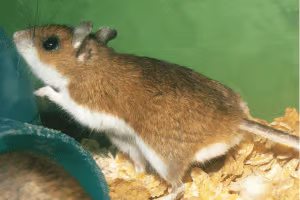
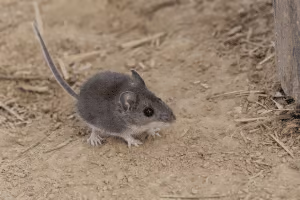
Deer mice (Peromyscus maniculatus) are native wild rodents measuring 3 to 4 inches in body length with a tail of roughly equal length. The most reliable identification feature is their sharply two-toned coloring: reddish-brown or grayish-brown on top with a clean white belly and white feet. The tail is also clearly bicolored, darker on top and white underneath. Large black eyes and prominent rounded ears give them a more alert, wide-eyed appearance compared to house mice.
Deer mice are agile climbers and prefer outdoor habitats, but move readily into structures when conditions outside become inhospitable. Females produce three to five litters per year with four to six young each, and like house mice they can squeeze through openings as small as a quarter inch. They nest in wall voids, attics, crawl spaces, and outbuildings, often using soft plant material, insulation, or shredded fabric. According to the Penn State Extension guide on IPM for mice, deer mice are among the most frequently encountered rodents in rural and semi-rural structures throughout the Northeast.
Signs of a Deer Mouse Infestation
Deer mouse activity tends to appear first in attics, basements, crawl spaces, and outbuildings, particularly near entry points. Because they often move in seasonally, signs can seem to appear suddenly rather than building gradually. Look for:
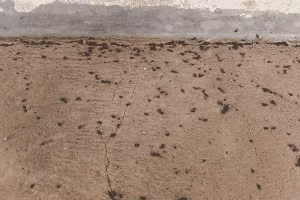
- Small, dark, rice-shaped droppings with pointed ends along walls, in corners, or near food storage
- Gnaw marks on food packaging, cardboard, insulation, or wooden structures
- Greasy rub marks along walls, pipes, and beams from repeated travel along the same routes
- Shredded paper, fabric, insulation, or dried grass gathered into nests in hidden voids
- Scratching or scurrying sounds inside walls, ceilings, or under floors at night
- Small holes or gaps around pipes, vents, chimneys, or foundations with nearby activity
- Seed shells or food debris near bird feeders, woodpiles, or garage storage areas
In Standish and Windham homes near wooded lots, I regularly find that activity spikes sharply in late October and November as deer mice seek shelter before the hardest cold sets in.
Risks in Southern Maine
Deer mice are the primary carrier of hantavirus in the Northeast, and that distinction matters significantly in Southern Maine given how much of the region is rural, forested, and bordering active wildlife habitat. Hantavirus pulmonary syndrome is transmitted through contact with deer mouse urine, droppings, or nesting material, including airborne particles that become disturbed during cleaning. The Maine CDC monitors hantavirus risk across the state, and properties near woodlines, fields, and agricultural land carry higher exposure potential. This is why cleanup of a confirmed or suspected deer mouse infestation requires more caution than a typical house mouse situation: ventilating the space, dampening surfaces before cleaning rather than dry-sweeping, and using appropriate protective equipment.
Beyond hantavirus, deer mice also contaminate food and surfaces with droppings and urine, and like house mice they serve as primary hosts for black-legged ticks, the species responsible for Lyme disease transmission in Maine. An active deer mouse population around or inside a structure contributes directly to tick and flea pressure on the property. Properties in rural areas like Limerick, Newfield, and Parsonsfield where deer mouse habitat overlaps closely with residential land tend to see the highest combined rodent and tick activity.
Prevention Tips
Deer mouse prevention is largely about reducing access to the structure and eliminating the outdoor conditions that bring them close to it in the first place:
- Seal all gaps larger than a quarter inch around foundations, chimneys, vents, pipes, and doors with steel wool, hardware cloth, or caulk
- Store all food, pet food, and birdseed in airtight metal or glass containers
- Remove woodpiles, rock piles, and dense vegetation at least 20 to 30 feet from the structure where possible
- Clean up spilled birdseed and fallen fruit promptly
- Install heavy-duty door sweeps, weatherstripping, and chimney caps
- Keep garages, attics, and crawl spaces free of clutter and stored materials that provide ready nesting sites
- Inspect firewood before bringing it indoors, as deer mice nest in stacked wood regularly
- Consider a year-round protection plan if your property borders significant wooded or agricultural land, where deer mouse pressure is ongoing rather than occasional
Commonly Confused With
Deer mice are most often confused with two other species:
House mice are similar in size but have uniformly grayish-brown fur with no white belly or white feet. House mice are year-round indoor residents rather than seasonal invaders and are more commonly found in urban and suburban settings. The absence of the two-toned coloring is the quickest distinguishing feature.
Norway rats are significantly larger, with bodies measuring 7 to 9 inches, a thick blunt tail shorter than the body, and gray-brown fur with a paler underside. If the animal you’re seeing is noticeably large, it’s a rat rather than a deer mouse.
White-footed mice (Peromyscus leucopus) look nearly identical to deer mice and share the same white belly and feet. They are slightly larger on average and tend to be more common in certain lowland and mixed-forest habitats. For practical pest control purposes the two species are handled the same way, but accurate identification matters for understanding hantavirus risk, as deer mice are the confirmed primary carrier in Maine.
Professional Deer Mouse Control in Southern Maine
When prevention alone isn’t enough, I provide thorough, low-impact treatment for deer mice customized to each property. Every job starts with a detailed inspection to locate all entry points, nesting sites, travel paths, and food sources, including gaps in foundations, wall voids, attics, and crawl spaces. From there I seal entry points first, then deploy only targeted controls exactly where needed: snap traps, live traps, or discreet tamper-resistant bait stations placed out of reach of pets and children. No broad applications and no unnecessary chemicals.
Because deer mice carry hantavirus, I also advise on safe cleanup protocols for contaminated areas, which is an important step that DIY approaches often skip. Every plan is customized to the property. A rural home in Standish with a wooded lot and an older foundation gets different attention than a seasonal camp in Casco that sits vacant through winter. I handle the entire process myself from start to finish, with follow-up visits included until the issue is fully resolved. Learn more about my background and credentials on the about page, or visit my rodent control service page for a full overview. Contact me to schedule a free inspection.
Frequently Asked Questions
Deer mice have a sharply two-toned coat with a white belly and white feet, and a clearly bicolored tail. House mice are uniformly grayish-brown with no white belly or feet. White-footed mice look nearly identical to deer mice but are slightly larger. For practical purposes, if you’re seeing a small mouse with a white belly and white feet in a rural or wooded area, it’s almost certainly a deer mouse or white-footed mouse, and both are handled the same way.
Yes. Deer mice are the primary carrier of hantavirus in the Northeast, including Maine. The virus is transmitted through contact with droppings, urine, or nesting material, including airborne particles disturbed during cleaning. Anyone cleaning up a confirmed or suspected deer mouse infestation should ventilate the area, avoid dry-sweeping, and use a mask and gloves. If there’s any uncertainty, a professional inspection is the safer starting point.
Most clients notice a significant drop in activity within the first week once entry points are sealed and traps are in place. Full elimination typically takes 30 days or longer depending on population size and how consistently exclusion steps are maintained. I schedule follow-up visits to confirm the problem is fully resolved and adjust the approach if needed.
Ready to Get Started?
If deer mice are getting into your home, camp, or outbuilding, reach out for a free inspection and I’ll identify where they’re entering and put together a plan to get them out and keep them out.