

Norway Rats in Southern Maine:
Identification, Prevention, and Control
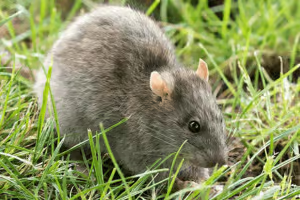
Norway rats are the largest commensal rodent I deal with in Southern Maine, and they tend to show up in specific contexts: older properties near water in Biddeford and Saco, commercial properties with dumpsters and loading areas, and residential neighborhoods in Portland and Westbrook where food waste and aging infrastructure give them everything they need. They’re cautious, strong, and capable of causing significant structural and health-related damage before most people realize they’re there. As an Associate Certified Entomologist (A.C.E.) with 16 years of experience in Cumberland and York Counties, I find that Norway rat problems are almost always more established than they first appear. Browse the rodents pest library to compare species, or contact me if you’re seeing signs and want a professional assessment.
What Are Norway Rats?
Norway rats (Rattus norvegicus), also called brown rats or sewer rats, are significantly larger than mice. Bodies measure 7 to 10 inches in length with a thick, scaly tail of 6 to 8 inches, shorter than the body. They have coarse brown to gray fur, a blunt snout, small rounded ears, and a paler underside. Their size alone usually distinguishes them immediately from mice.
Norway rats are ground-level animals. Unlike roof rats, which prefer elevated areas and are uncommon in Maine, Norway rats burrow along foundations, under slabs, and in crawl spaces. They’re capable swimmers, competent climbers when necessary, and can enter structures through gaps as small as a half inch. Females produce 4 to 7 litters per year with 8 to 12 young each, reaching reproductive maturity in about two months. A small rat problem can scale into a large one faster than most people expect. According to the Maine DACF Got Pests rats page, Norway rats are the rat species found in Maine and are closely associated with human settlements and food sources.
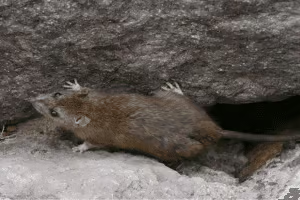
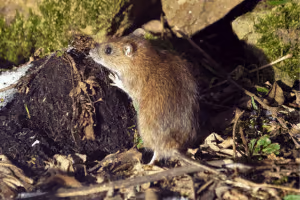
Signs of a Norway Rat Infestation
Norway rat signs are distinctly larger and more substantial than what mice leave behind. Activity tends to concentrate near foundations, basements, and food storage areas first. Look for:
- Large, dark droppings up to three-quarters of an inch long with blunt ends, often found in groups along walls or near food sources
- Wide, greasy rub marks along baseboards, pipes, beams, and foundation edges from repeated travel
- Burrows with smooth, worn entrance paths near foundations, under decks, along retaining walls, or in crawl spaces
- Heavy gnaw marks on plastic, wood, pipes, or electrical wiring
- Scratching, thumping, or running sounds inside walls, under floors, or in crawl spaces, particularly at night
- A strong ammonia-like odor in enclosed spaces from accumulated urine
- Tracks in dust or mud near entry points, or torn packaging in pantries and storage areas
In Biddeford and Saco, I tend to see rat activity increase in late summer and fall as outdoor food sources become less reliable and populations push toward structures.
Risks in Southern Maine
Norway rats pose genuine health and structural risks that go well beyond what mice typically cause. They can bite if cornered, and they contaminate food and surfaces with urine, droppings, and hair. They are a known vector for leptospirosis, which is transmitted through rat urine contaminating water or soil, and can also carry Salmonella and other bacteria. The Maine CDC is the appropriate reference for current disease risk guidance in Maine.
Structurally, Norway rats are among the most damaging rodents a property owner can face. Their gnawing is powerful enough to work through lead pipes, concrete block, and aluminum sheeting, and chewed electrical wiring is a well-documented cause of house fires. Burrow activity along foundations can undermine slabs, compromise vapor barriers, and create drainage problems over time. In commercial food service environments, a confirmed rat presence represents an immediate regulatory and liability concern.
Norway rats can also draw in other problems. An active rat population is a food source for larger predators, and properties with rats near wooded edges sometimes see increased nuisance wildlife activity as a result. Like mice, rats also contribute to tick and flea pressure on the property.
Prevention Tips
Norway rat prevention requires attention to both entry points and the outdoor conditions that attract them to a property in the first place:
- Seal all gaps larger than a half inch around foundations, doors, windows, pipes, vents, and sewer connections with steel wool, hardware cloth, or concrete
- Store all food, pet food, and garbage in heavy-duty metal or thick hard-sided containers with tight-fitting lids
- Keep dumpsters tightly closed and on a consistent emptying schedule
- Remove woodpiles, debris, and dense vegetation near the foundation that provide cover and harborage
- Fix leaks and improve drainage around foundations and crawl spaces, as Norway rats are drawn to moisture
- Install heavy-duty door sweeps, weatherstripping, and metal flashing along foundation edges
- Clean up spilled birdseed, pet food, and fallen fruit promptly
- Consider a year-round protection plan for properties with persistent pressure from nearby harborage areas or food sources
Commonly Confused With
Norway rats are occasionally misidentified, particularly when only droppings or damage are found rather than the animal itself.
House mice are far smaller, with rice-grain droppings, fine gnaw marks, and a tendency to nest in wall voids and upper areas of structures rather than at ground level. If the droppings are noticeably large or burrow activity is present, it’s a rat.
Deer mice are also much smaller and are identified by their two-toned coloring with a white belly and white feet. They’re common in rural and wooded settings but do not burrow along foundations or cause the scale of structural damage associated with Norway rats.
Roof rats (Rattus rattus) are occasionally a point of confusion for homeowners who have read about them online. Roof rats are uncommon in Maine and tend to be found in warmer coastal regions further south. The rat species you’re dealing with in Southern Maine is almost certainly a Norway rat.
Professional Norway Rat Control in Southern Maine
Norway rats are one of the more demanding rodent problems to resolve properly, because sealing entry points and controlling the existing population have to happen in the right sequence and with the right methods. I start every job with a thorough inspection to locate all burrow sites, entry points, travel paths, and food sources, including foundation gaps, sewer connections, and any structural vulnerabilities that aren’t obvious without a trained eye. From there I seal entry points first, then deploy targeted exterior tamper-resistant bait stations, snap traps, or other controls exactly where the evidence indicates activity. No broad applications and no unnecessary chemicals.
Norway rat problems in commercial properties require additional attention to documentation, sanitation protocols, and scheduling that minimizes disruption to operations. I handle both residential and commercial accounts myself from start to finish, with follow-up visits included until the issue is fully resolved. Learn more about my background and credentials on the about page, or visit my rodent control service page for a full overview of how I handle rats, mice, and rodent-proofing across Southern Maine. Contact me to schedule a free inspection.
Frequently Asked Questions
Norway rats are much larger, with bodies measuring 7 to 10 inches, blunt snouts, small ears, and thick tails shorter than the body. House mice are small and uniformly grayish-brown with much finer droppings. Roof rats have longer tails relative to body length and prefer elevated areas like attics, but they are uncommon in Maine. If you’re finding large droppings or burrow activity along a foundation in Southern Maine, it’s almost certainly a Norway rat.
Norway rats generally avoid people but will bite if cornered or handled. More significant is the indirect health risk: they are a known vector for leptospirosis, which is spread through contact with rat urine in water or soil, and can also carry Salmonella. Contaminated food preparation surfaces and stored food are a serious concern wherever rat activity is present. Professional handling is strongly recommended over DIY approaches.
Norway rats are cautious animals and may take several days to engage with new bait stations or traps, which is normal behavior. Most clients see a clear reduction in activity within one to two weeks. Full elimination typically takes 30 days or longer depending on population size, the extent of burrow activity, and how consistently sanitation and exclusion steps are maintained. I schedule follow-up visits to confirm the problem is fully resolved and adjust the approach if needed.
Ready to Get Started?
If Norway rats have found their way onto your property or into your building, reach out for a free inspection and I’ll assess the extent of the activity and put together a plan to eliminate it.