

Phorid Flies in Southern Maine:
Identification, Prevention, and Control
Phorid flies are the small fly species I take most seriously when they appear indoors, and for good reason. While fruit flies and drain flies are nuisances tied to kitchen maintenance issues, phorid flies are often indicators of something more significant: a broken sewer line, a failing drain, a hidden carcass in the structure, or a serious organic buildup in a place that is difficult to access. The running behavior, the humpbacked profile, and the tendency to appear in places where no obvious breeding source is visible are all signals worth paying attention to. I encounter them across Cumberland and York Counties in both residential properties and commercial environments, and the investigation required to resolve them is more involved than most other small fly situations. As an Associate Certified Entomologist (A.C.E.) with 16 years of experience in the region, finding the source is the entire job with phorid flies. Browse the flies pest library to compare other species common in Maine, or contact me if small dark running flies are appearing indoors and the source is not obvious.
What Are Phorid Flies?
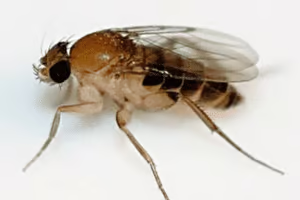
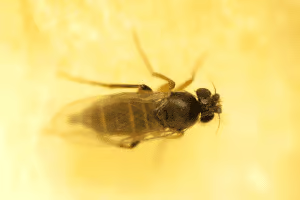
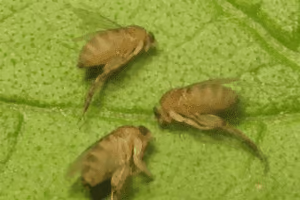
Phorid flies belong to the family Phoridae and are sometimes called humpbacked flies or scuttle flies, both names that describe their most distinctive features. Adults are very small, ranging from about one-sixteenth to one-eighth inch in length, with a markedly arched thorax that gives them a pronounced humpbacked profile. They are dark brown to black and their most recognizable behavioral trait is the way they move: rather than hovering or landing and staying put like most small flies, phorid flies run rapidly across surfaces in short erratic bursts, pausing and then scurrying again. This running behavior is the fastest way to identify them.
Females lay eggs in an unusually wide range of decaying organic substrates, including drain biofilm, sewage, garbage, decaying vegetation, animal carcasses, and even the remains of other insects. This broad tolerance for organic matter is what makes them such effective indicators of hidden sanitation problems. The life cycle can complete in as little as 14 to 21 days under warm humid conditions. Browse the flies pest library to see other species found in the area.
According to Penn State Extension, phorid flies are one of the most common small fly species encountered in commercial food service environments and are particularly associated with drains, plumbing failures, and decaying organic matter in inaccessible locations.
Signs of Phorid Fly Activity
The running behavior is the first thing to look for. Other signs include:
- Tiny dark flies running in rapid jerky bursts across counters, floors, walls, or drain covers rather than hovering or flying
- Activity near floor drains, sink drains, garbage disposals, or areas with plumbing penetrations
- Flies appearing in basements, crawl spaces, or utility areas with no obvious food source nearby
- Persistent activity that continues after standard drain cleaning, which suggests a source beyond the visible drain interior
- Flies emerging from wall voids, under flooring, or from areas adjacent to plumbing
- Activity in commercial kitchens, food processing areas, or anywhere with complex drain systems
In Southern Maine locations such as Biddeford and Scarborough phorid fly activity in older homes with aging plumbing and damp basements is a year-round possibility, with activity intensifying during humid summer and fall months when organic decomposition accelerates.
Risks in Southern Maine
Phorid flies do not bite and are not significant direct disease vectors, but they carry bacteria from the organic matter they breed in and can contaminate food preparation surfaces and stored food if they gain access to kitchen areas. In commercial food service environments this represents a real sanitation and regulatory concern, and phorid fly activity in a restaurant or food processing facility is taken seriously by health inspectors precisely because of what it often indicates about the underlying drain or plumbing condition.
The more meaningful risk in both residential and commercial settings is what phorid fly activity signals about the structure. A persistent phorid fly problem that does not resolve with standard drain cleaning frequently indicates a broken sewer line allowing sewage to accumulate under a slab, a failed drain connection, or a hidden carcass. These are infrastructure problems that cost considerably more to address when they go undetected. In that sense, phorid flies are one of the more useful warning signs a building can produce. My commercial pest control services address phorid fly activity in food service and commercial environments as part of a broader integrated pest management approach that treats the symptom and helps identify the underlying cause.
Prevention Tips
Phorid fly prevention requires keeping organic matter from accumulating in plumbing and accessible areas, with particular attention to the less-obvious locations:
- Clean all floor drains weekly with a stiff brush and enzymatic cleaner, not just a water flush
- Keep garbage disposals clean with regular enzymatic treatment and cold water flushing
- Fix plumbing leaks promptly, including slow drains, since standing water in drain lines accelerates organic buildup
- Keep crawl spaces dry and well-ventilated to prevent the moist organic conditions phorid flies breed in
- Remove any dead animals from the property promptly, including checking for carcasses in wall voids or attic spaces if flies are appearing from structural areas
- In commercial settings, establish a documented drain cleaning schedule and inspect grease traps regularly
- Seal gaps around plumbing penetrations to reduce fly movement from infested drain systems into living or working areas
Commonly Confused With
Phorid flies are most commonly confused with fruit flies and drain flies. Fruit flies are tan with distinctive red eyes and hover around produce and recycling rather than running across surfaces. Drain flies are fuzzy and moth-like with broad tent-shaped wings and rest motionless near drain openings rather than scurrying. Fungus gnats are long-legged and delicate, hovering weakly above houseplant soil. The running behavior of phorid flies is their single most reliable identifier. No other common small fly species in Southern Maine scurries across surfaces in the same characteristic way. If a small dark fly runs rather than flies when disturbed, it is almost certainly a phorid fly.
Professional Phorid Fly Control in Southern Maine
Phorid fly treatment requires finding the source, which is often the most challenging part. Standard drain cleaning resolves phorid fly problems when the breeding site is in an accessible drain. When activity persists after thorough drain treatment, the source is somewhere less obvious — under a slab, in a wall void, in a crawl space, or in a plumbing failure that is allowing sewage to accumulate where it should not be. I inspect the full structure systematically, including all drains, plumbing penetrations, crawl spaces, and wall voids, to locate the breeding material before applying any product. In situations where a broken sewer line or plumbing failure is the likely source, I can help identify where the problem is occurring so the right contractor is brought in to address it. For commercial properties where phorid fly activity intersects with food safety compliance, my commercial pest control services include phorid fly management as part of a structured integrated pest management program. You can learn more about my approach and background on the about page. My common pests control services cover phorid flies and the full range of fly species found in Cumberland and York Counties. Contact me to schedule a free consultation.
Frequently Asked Questions
Phorid flies can breed in organic matter that is not visible at the drain opening. The biofilm layer inside drain pipes can extend well beyond the visible portion, and a single neglected floor drain or a slow-running drain that retains moisture is enough to sustain a population. More significantly, if the activity does not resolve after thorough drain cleaning, the source may be outside the drain system entirely, such as a broken sewer line allowing sewage to pool under a concrete slab, a plumbing joint failure in a wall or crawl space, or a dead animal in the structure. Persistent phorid fly activity that does not respond to standard treatment is worth a professional inspection to rule out a plumbing problem.
Yes, and this is one of the more practically important things to know about this species. When phorid flies emerge from cracks in a concrete slab floor, from wall base areas, or from locations with no obvious drain or organic source, a broken sewer line or drain failure allowing sewage to accumulate under or within the structure is one of the most common explanations. The flies breed in the sewage and emerge through any available gap. This is a plumbing issue, not a pest control issue, but identifying phorid flies correctly is what points the investigation in the right direction.
No. They are related in that both are small flies found in kitchens, but they are different species with different breeding preferences and different behaviors. Fruit flies are tan with red eyes and hover around fermented or ripe organic material. Phorid flies are darker, have a humpbacked profile, and run across surfaces rather than hovering. Most importantly, phorid flies in a kitchen often indicate a drain or plumbing problem rather than a food storage issue, so the response is different. If a small fly in your kitchen runs when you approach it rather than flying, it is almost certainly a phorid fly rather than a fruit fly.
Ready to Get Started?
If small dark running flies are appearing indoors and the source is not obvious, reach out for a free inspection and I will find it.