

Citronella Ants in Southern Maine:
Identification, Prevention, and Control
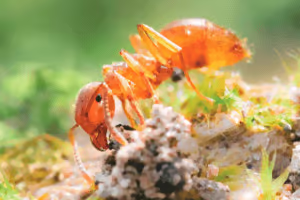
Citronella ants are a common but often misidentified pest in Southern Maine. Most homeowners first encounter them not as individual foragers but as a sudden indoor swarm of winged ants in late summer or fall, which are frequently mistaken for termites. The name comes from the strong lemon or citronella odor they release when crushed. As an Associate Certified Entomologist (A.C.E.), I identify these regularly throughout Cumberland and York Counties, and correct identification before any treatment is essential since these ants require a very different approach than most species. Browse the ants pest library for a full overview of ant species found in the area, or contact me if you need a professional assessment.
What Are Citronella Ants?
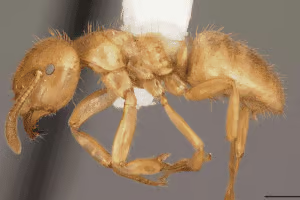
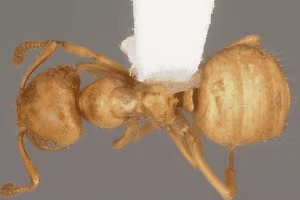
Two species of citronella ants are found in Maine. The smaller yellow ant (Lasius claviger) measures 3-4mm while the larger yellow ant (Lasius interjectus) measures 4-4.5mm. Both species are pale yellow to light orange-brown and are sometimes called “yellow ants” in the field. Workers in each colony are monomorphic, meaning they are all roughly the same size. The key identification feature in either species is that unmistakable lemon verbena or citronella scent released when the ants are disturbed or crushed.
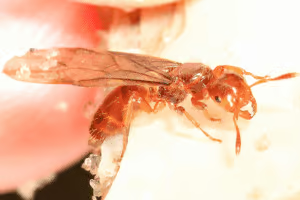
These are subterranean insects that live almost entirely underground, tending aphids and mealybugs on plant roots and feeding on the honeydew they produce. They rarely forage indoors for food and do not attack stored goods or structural wood. The only time most homeowners notice them is during swarming events, when winged reproductives emerge in large numbers. According to Penn State Extension, swarms most commonly occur in mid to late summer but have been documented in late fall and early spring as well, particularly near heated structures where soil stays warm.
Signs of Infestation
- A sudden appearance of large numbers of winged yellow ants indoors, typically from August through October
- A strong lemon or citronella smell when ants are crushed or disturbed
- Small mounds of excavated soil near foundation cracks, expansion joints in slabs, or around door openings
- Small pale yellow ants trailing along basement walls or foundation areas
- Ants emerging through cracks in concrete floors or around utility penetrations
Risks in Southern Maine
Citronella ants are strictly a nuisance pest. They do not cause structural damage, do not contaminate food, and do not spread disease. Their presence indoors is temporary since they cannot establish a colony inside a structure. The main concerns are the alarm caused by a large indoor swarm and the unpleasant odor when ants are crushed.
That said, repeated swarming events in the same location often indicate a well-established colony in the soil immediately adjacent to the foundation. The presence of moist, conducive soil near the structure is worth addressing both to discourage citronella ants and to prevent other moisture-related pest issues from developing over time.
Prevention Tips
- Seal cracks and expansion joints in concrete slabs, foundations, and around door frames where swarmers commonly enter
- Reduce moisture near the foundation by improving drainage, grading soil away from the structure, and fixing any leaks
- Keep mulch, leaf litter, and organic debris at least 12 inches from the foundation
- Remove stones, logs, boards, and other ground-level items that create sheltered nesting conditions in soil
- Inspect and dry any chronically damp areas in basements and crawl spaces
- Consider a year-round protection plan if your property has recurring moisture issues near the foundation, which create ongoing nesting conditions for citronella ants and other species
Commonly Confused With
Citronella ant swarmers are one of the most common insects mistaken for termites in Southern Maine, particularly when they emerge indoors in large numbers. The lemon scent is the fastest way to distinguish them since termites produce no notable odor. Structurally, citronella ant swarmers have elbowed antennae, a pinched waist, and wings of unequal size, while termites have straight antennae, a thick uniform waist, and equal-length wings.
They are also confused with odorous house ants due to their similar small size. The key difference is color and scent: citronella ants are pale yellow and smell like lemons, while odorous house ants are dark brown to black and smell like rotten coconut when crushed.
Professional Citronella Ant Control in Southern Maine
Because citronella ants nest entirely underground and do not forage indoors for food, standard ant baits placed inside the home are largely ineffective. Control requires locating the outdoor colony near the foundation and treating at the nest site directly. I handle every job personally and use targeted, low-toxicity treatments suited to the nesting behavior of this specific species. If citronella ants are swarming indoors, my ant control services cover identification, nest location, and treatment to stop recurring swarm events. Contact me to schedule a free consultation.
Frequently Asked Questions
- Most likely not. Citronella ant swarmers are very commonly mistaken for termites in Southern Maine, especially when they emerge indoors in large numbers in late summer or fall. Crush one gently — if it smells like lemons, it is a citronella ant. If you are unsure, I am happy to identify them for you at no charge.
No. Citronella ants do not eat wood, damage structures, or contaminate food. They are a nuisance pest. The swarmers that enter your home will not reproduce indoors and will die off on their own. The concern worth addressing is the outdoor colony in the soil near your foundation, which will keep producing swarms until it is treated.
The swarms will keep recurring as long as the colony exists in the soil adjacent to the structure. Sealing entry points helps reduce the number that get indoors, but eliminating the colony at the nest site is the only lasting solution. I locate the nest and treat it directly, which typically resolves recurring swarm events within one season.
Ready to Get Started?
I serve homeowners and businesses throughout Cumberland and York Counties. If citronella ants are swarming indoors, reach out for a free consultation.