

Carpenter Ants in Southern Maine:
Identification, Prevention, and Control
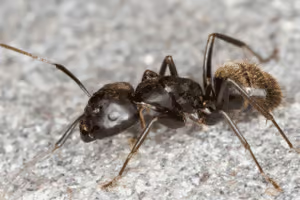
Carpenter ants are the most common structural pest I treat across Southern Maine, and for good reason. They thrive in the wooded, moisture-prone landscapes of Cumberland and York Counties, and a mature colony left untreated can cause serious damage to beams, sills, and framing over time. As an Associate Certified Entomologist (A.C.E.), carpenter ant identification and treatment is something I handle more than any other pest in this region. Browse the ants pest library to see other ant species found in Southern Maine, or contact me if you suspect an infestation.
What Are Carpenter Ants?
Carpenter ants are large wood-nesting insects in the genus Camponotus. In Southern Maine the Eastern black carpenter ant (Camponotus pennsylvanicus) is by far the most common species, though the New York carpenter ant (Camponotus novaeboracensis) is also encountered. A key fact that surprises many homeowners: carpenter ants do not eat wood. They excavate it to create galleries for nesting, pushing out coarse sawdust-like frass as they tunnel. The structural damage comes from that excavation, not from consumption.
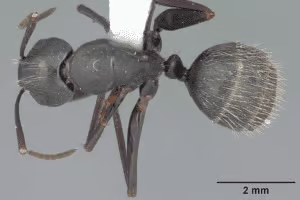
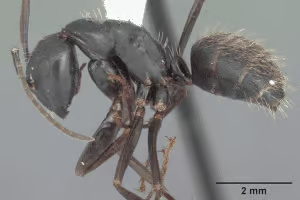
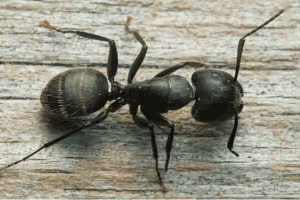
These ants are polymorphic, meaning workers in the same colony vary significantly in size. Minor workers are about 1/4 inch long while major workers can reach 1/2 inch or more. They are typically black or reddish-black with a smooth, evenly rounded thorax profile and elbowed antennae. Colonies can range from a few hundred to several thousand individuals, with a single parent colony often establishing satellite colonies inside structures while the main nest remains in a nearby tree stump or log. The University of Maine Cooperative Extension has thorough documentation of carpenter ant species found in Maine, including the smaller carpenter ant (Camponotus nearcticus) which is occasionally misidentified.
Signs of a Carpenter Ant Infestation
Early detection prevents significant damage. Common indicators include:
- Piles of frass near wood structures. Carpenter ant frass is coarse, like sawdust mixed with insect parts and bits of insulation, which distinguishes it from the fine powder left by powderpost beetles.
- Hollow or weakened wood in beams, window frames, door frames, or decks
- Large black ants foraging indoors, especially after dark when workers are most active
- Winged swarmers emerging indoors in spring, which signals a mature colony already established inside or nearby
- Faint rustling or crackling sounds inside walls or ceilings, particularly at night
Risks in Southern Maine
Carpenter ants are classified as wood-destroying pests, and for good reason. Over time their tunneling hollows out structural wood, weakening load-bearing beams, floor joists, window sills, and deck framing. The damage is cumulative and often hidden inside wall voids until it becomes extensive. Unlike termites, they do not consume the wood, but the structural impact of a large established colony can be equally serious if left untreated for multiple seasons.
They do not spread disease and their bite is mild, but their presence often signals an underlying moisture problem that will keep attracting them unless addressed. The Maine Forest Service notes that in most cases a carpenter ant infestation indicates a construction or moisture problem that needs to be corrected alongside any treatment.
Prevention Tips
- Fix leaks promptly and improve ventilation in crawl spaces, basements, and under eaves to eliminate the moisture that attracts carpenter ants to wood
- Replace any soft, decaying, or water-damaged wood around the structure
- Store firewood off the ground and well away from the house, and use each season’s supply completely rather than carrying it over indoors
- Remove tree stumps, logs, and debris piles near the foundation
- Trim branches and shrubs so they do not contact the roof or siding
- Seal entry points around utility lines, pipes, and foundation gaps before spring when colonies become active
- Consider a year-round protection plan if your property has persistent moisture issues or heavy tree coverage, both of which create ongoing nesting opportunities
Commonly Confused With
Carpenter ants are most often confused with two things: termites and other large ant species.
Termites are the more serious concern to rule out. Carpenter ant winged swarmers and termite swarmers both appear in spring and are frequently mistaken for each other. The key differences are that carpenter ants have elbowed antennae, a pinched waist, and wings of unequal size. Termites have straight antennae, a thick uniform waist, and equal-length wings. Carpenter ant frass is coarse and dry. Termite damage involves mud tubes and the wood itself is eaten rather than excavated. If you find swarmers indoors, do not assume which one it is before treatment.
Acrobat ants are another common mix-up. Both nest in decaying wood, but acrobat ants are much smaller at around 1/8 inch and raise their heart-shaped abdomen when disturbed. Carpenter ants are significantly larger and do not display that behavior.
Professional Carpenter Ant Control in Southern Maine
Carpenter ant treatment requires finding and addressing both the satellite colony inside the structure and the parent colony, which is often located in a tree stump, log, or landscape timber nearby. Treating only what is visible indoors is one of the most common reasons DIY attempts fail. I locate both nest sites, use targeted low-toxicity treatments, and address the moisture conditions contributing to the problem. My ant control services cover the full process from inspection through resolution. Contact me to schedule a free consultation.
Frequently Asked Questions
Look at the frass first. Carpenter ant frass is coarse and dry, like sawdust mixed with insect debris. Termites leave mud tubes and their damaged wood has a layered, eaten appearance. If you find winged swarmers, carpenter ants have elbowed antennae and a pinched waist while termites have straight antennae and a thick uniform body. When in doubt, I am happy to identify what you are dealing with at no charge.
Yes, over time. A large established colony can hollow out structural beams, floor joists, and window framing significantly. The damage accumulates over multiple seasons and is often hidden inside walls until it becomes expensive to repair. Early treatment is always far less costly than addressing the structural consequences of a long-term infestation.
Most treatments show significant improvement within one to two weeks. Full resolution typically takes two to four weeks depending on colony size and whether satellite colonies are present inside the structure. I follow up to confirm the problem is fully resolved before considering the job done.
Ready to Get Started?
I serve homeowners and businesses throughout Cumberland and York Counties. If carpenter ants are damaging your home, reach out for a free consultation.